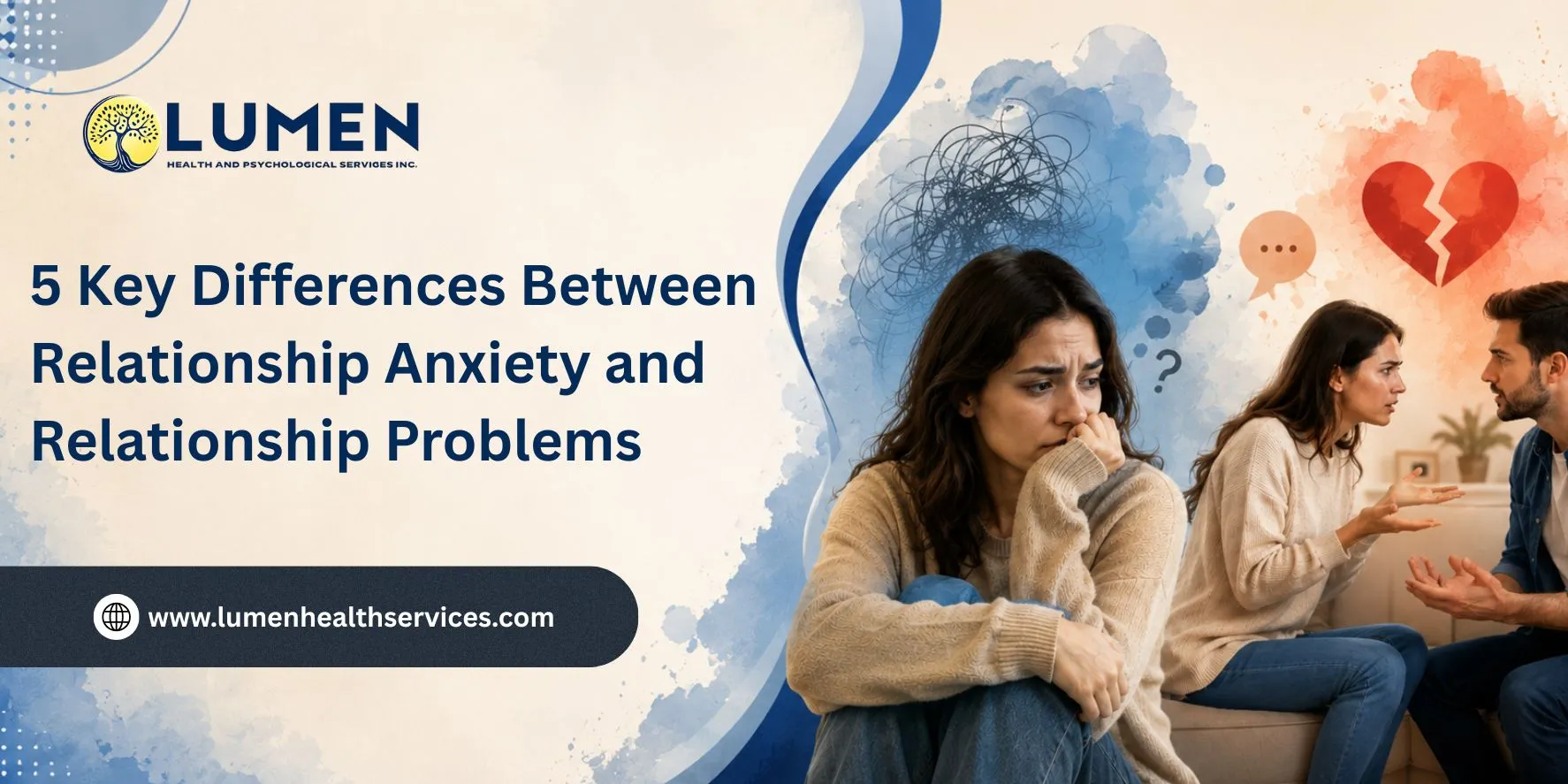
The inside of relationship anxiety and relationship problems are alike. Both feel distressing. Both make you wonder about your relationship. However, they are different and advanced in various ways, with various treatments and outcomes.
The major difference is that relationship anxiety is on the inside, stemming from fear, attachment patterns, and anxious thinking. When there is a problem between two individuals, it is a real relationship problem because it is based on genuine incompatibility, on negative behaviours or unresolved conflict.
This distinction is an important one. When people come to you with anxiety problems, they don’t need couples therapy, they need individual therapy. When a true relationship issue is answered with anxiety, it renders one able to ignore reasonable issues and remain in scenarios that are failing them.
This guide outlines what each constitutes, the five most obvious distinctions, and when therapy is the next step.
What Is Relationship Anxiety?
Relationship anxiety is a pattern of persistent doubt, worry, and insecurity within a relationship that does not resolve even when things are objectively going well. The person experiencing it often cannot identify a specific, current problem. Instead, they feel a constant low-level unease that shifts between different concerns.
Common thoughts in relationship anxiety include:
- What if I do not love them enough?
- What if they leave me?
- What if I am making a mistake?
- What if there is someone better out there?
These thoughts feel urgent and real, but they do not point to a specific, identifiable issue in the relationship. They are the anxiety speaking, not the relationship revealing a problem.
Relationship anxiety is not currently listed in the DSM-5 as a standalone diagnosis. It most closely overlaps with generalized anxiety disorder (GAD), attachment-based anxiety, and in more severe cases, relationship-centered obsessive compulsive disorder, known as ROCD. Attachment research consistently shows that people with anxious attachment styles are significantly more likely to experience relationship anxiety regardless of partner quality.
What Are Relationship Problems?
Relationship problems are real, observable difficulties that exist between two people. They are not generated by one person’s internal anxiety. They are created by how two people interact, communicate, and treat each other.
Common relationship problems include:
- Repeated patterns of dishonesty or broken trust
- Chronic communication breakdowns where neither person feels heard
- Persistent conflict that does not resolve
- Emotional or physical disconnection over time
- Incompatible values, goals, or life plans
- One or both partners not putting in effort to maintain the relationship
The key feature of real relationship problems is that they are verifiable. A partner who consistently dismisses your concerns is a real problem. A recurring pattern of lying is a real problem. A partner who is loving, consistent, and available, but about whom you feel constant doubt, is more likely to be relationship anxiety.
5 Key Differences Between Relationship Anxiety and Relationship Problems
1. Where the Doubt Originates
Doubt in relationship anxiety comes from within. It is present even when your partner has done nothing wrong, even when the relationship is peaceful, and even when you are away from your partner. The doubt does not stem from any incident, it follows you.
In real relationship issues, doubt comes because of certain occurrences or trends. You can identify and discuss events, when they happened, and how they made you feel. The concern has a clearly identifiable external cause.
2. Whether It Resolves With Reassurance
When reassured, relationship anxiety will come up and go down, yet the fear always returns, attaching itself to another concern again. This is a comforting talk that for a while makes them feel better, but the concerns come back in a new form. It is the cycle of seeking reassurance and feeling temporarily better which is characteristic of anxiety-driven doubt.
Reassurance is not enough for real relationship issues to be solved. Saying that you trust your partner when he or she has cheated will not earn trust. Sustainable change is needed, not merely words, for the real problem.
3. How Specific the Problem Is
Relationship anxiety tends to be vague and shifting. The concern jumps between topics: attraction, love, compatibility, the future. It rarely settles on one concrete, specific issue.
Real relationship problems are specific. “We have not been physically intimate in four months and neither of us has brought it up” is specific. “I do not feel fully attracted to my partner, but I cannot explain why” may be anxiety.
4. Whether the Pattern Existed Before This Relationship
Relationship anxiety often follows the person across relationships. If you experienced the same doubt and worry in previous relationships with different partners, the pattern is more likely internal than relational.
Real relationship problems are more specific to the current relationship. If this is the first time you have felt this way, and you can point to what changed or what your partner does that creates the problem, that points toward a real relationship difficulty.
5. Whether You Feel Safe With Your Partner
This difference is the most clinically significant. In relationship anxiety, the person typically feels safe and loved when they are with their partner. The anxiety is more present when apart, when overthinking, or when triggered by an intrusive thought.
In real relationship problems, you often do not feel fully safe or secure with your partner, even when things appear calm. Something in the relationship itself creates a persistent sense of unease or unsafety.
Common Relationship Problems Couples Actually Face
Understanding what counts as a real relationship problem helps distinguish it from anxiety. Common relationship problems include:
Communication breakdown: Partners stop expressing needs clearly, start assuming the other person knows what they want, and build resentment through unexpressed expectations. This is one of the most frequent issues couples bring to therapy.
Trust issues: Trust breaks through infidelity, dishonesty, or repeated boundary violations. Once broken, trust requires deliberate, consistent repair over time. It does not return through reassurance alone.
Long distance relationship problems: Physical separation creates specific strains: reduced connection, different daily rhythms, jealousy, and the challenge of maintaining intimacy without proximity. These are real, situational problems that require active management.
Age gap relationship problems: Significant age differences can create real divergences in life stage, energy levels, social circles, and long-term goals. These are not automatically dealbreakers, but they require honest, direct conversation to assess whether the gap is creating genuine incompatibility.
Marital relationship problems: Marriage introduces financial entanglement, potential parenting responsibilities, and changes in individual identity that create friction even in strong relationships. Common marital problems include decision-making conflict, unequal labor division, and loss of partnership identity over time.
Sexual and physical intimacy: Mismatched desire levels, changes in physical attraction over time, and avoidance of physical connection are common relationship problems that affect many couples but are rarely discussed openly until they become critical.
Trust Issues in a Relationship: What They Actually Are
Trust issues deserve a dedicated discussion because they sit at the intersection of anxiety and real problems.
Some trust issues are anxiety-driven. A person with an anxious attachment history may struggle to trust even a loyal, consistent partner because their nervous system anticipates abandonment. This is an anxiety problem, not a relationship problem, and the solution is individual therapy focused on attachment.
Other trust issues are response to genuine betrayal. A partner who has lied, been unfaithful, or repeatedly broken agreements creates a rational basis for distrust. This is a real relationship problem requiring couples therapy focused on accountability, repair, and rebuilding trust over time.
The practical question is: “Does my distrust correspond to actual behavior, or is it a fear of what might happen despite no evidence?”
How to Start Solving Relationship Problems
For real relationship problems, the following approaches have strong evidence behind them:
Communication is the key to resolve a relationship issue, and that begins with knowing the actual problem. Rather than expressing disconnection, have a conversation about what is causing the disconnection. For instance, “We have not had a meaningful conversation about our future in weeks” as your partner should understand the issue at hand, which allows you to work through a solution rather than feeling like you’re being misunderstood or stuck.
It’s not just about how you approach the disagreements. Engage in open and respectful dialogue instead of faultfinding and criticism. Use “I” statements to share feelings, try to listen without interrupting, and try to understand the other person’s point of view before you respond. The following communication skills can help minimize disagreements and help restore trust with time.
If your efforts are still failing to produce desired results when the same issues repeatedly arise, then it’s time to get some professional help. Couples often spend years putting up with minor problems, which may worsen over time. The sooner you begin couples therapy, the sooner you will have tools that help you to communicate more effectively, resolve disputes and deepen and enhance your relationship before it becomes more difficult.
When Family Relationships Become Difficult
Relationship difficulties extend beyond romantic partnerships. Family relationships carry their own patterns of conflict, unmet expectations, boundary violations, and communication breakdowns.
Family relationship problems often involve:
- Parents and adult children navigating changing power dynamics
- Sibling conflict over family responsibilities or resources
- Extended family interference in a couple’s relationship
- Estrangement as a response to chronic boundary violations
Family therapy addresses these patterns directly. It works best when at least two members of the family are willing to participate, though individual therapy can also help a person navigate a difficult family relationship without the other party present.
When Is Therapy the Right Choice?
Therapy is appropriate for both relationship anxiety and real relationship problems, but the type of therapy differs.
Individual Therapy for Relationship Anxiety
If your worries are driven by constant overthinking, fear of abandonment, or repeated doubts despite having a healthy relationship, individual therapy is usually the best place to start. Cognitive Behavioral Therapy (CBT) is one of the most effective treatments for anxiety because it helps you recognize and change negative thought patterns. Attachment-focused therapy can also help you understand how past relationships or childhood experiences may be influencing your current relationship and teach you how to develop healthier, more secure attachment patterns.
Couples Therapy for Relationship Problemsa
When relationship challenges stem from ongoing conflict, poor communication, broken trust, or incompatible goals, couples therapy is often the most effective approach. Evidence-based methods such as Emotionally Focused Therapy (EFT) help couples understand the emotional needs behind their conflicts, while the Gottman Method focuses on improving communication, resolving disagreements, and rebuilding trust through practical, research-backed strategies.
Therapy for Trust Issues After Betrayal
Trust issues caused by infidelity, dishonesty, or repeated broken promises often require specialized couples therapy. Affair recovery and trust repair therapy help couples process the emotional impact of betrayal, rebuild accountability, restore emotional safety, and create a healthier foundation for moving forward together.
Marriage Counseling for Long-Term Relationship Challenges
Marriage counseling can help couples navigate ongoing issues such as frequent arguments, emotional distance, parenting disagreements, financial stress, or major life transitions. It provides practical communication tools, helps partners understand which problems can be resolved, and supports them in making informed decisions about strengthening their relationship.
Not Sure Which Type of Therapy You Need?
If you’re unsure whether you’re dealing with relationship anxiety or a genuine relationship problem, starting with an individual therapist is often the best first step. A mental health professional can help you identify whether your concerns are rooted in anxiety, attachment patterns, or real relationship challenges and guide you toward the most appropriate treatment, whether that’s individual therapy, couples therapy, or a combination of both.
If you are in California and looking for individual therapy or couples therapy, Lumen Health offers in-person sessions in Citrus Heights and online therapy across California. Book a consultation today.
How to Find the Right Therapist for Relationship Issues in California
When selecting a therapist for relationship anxiety or relationship problems in California, consider:
Choose the Right Type of Therapist
The first step is choosing a therapist who matches your needs. If your concerns are mainly driven by overthinking, fear of abandonment, or constant doubt, an individual therapist can help you understand and manage relationship anxiety. If you and your partner are dealing with ongoing communication problems, trust issues, or recurring conflict, a couples therapist is usually the better choice because they work with both partners to improve the relationship together.
Look for Specialized Training
Not all therapists use the same treatment approaches, so it’s helpful to ask about their experience and training. Therapists who specialize in Cognitive Behavioral Therapy (CBT), Emotionally Focused Therapy (EFT), or the Gottman Method use evidence-based techniques that have been shown to improve communication, reduce anxiety, strengthen emotional connection, and help couples resolve relationship challenges more effectively.
Consider Location and Accessibility
Choose a therapist whose services fit your lifestyle and location. If you’re in California, online therapy can make it easier to access experienced mental health professionals without the need to travel. Virtual sessions are especially helpful if you’re in areas where in-person appointments have long wait times, allowing you to get support sooner and more conveniently.
Conclusion
Relationship anxiety and relationship problems are different and need different interventions. The wrong treatment for either condition will extend the problem and frequently exacerbate it. The most obvious one is if the doubt has a clear and identifiable external source or if it sticks with you no matter what you do as a couple.
If it’s difficult to distinguish, it’s difficult to distinguish. And that’s worth exploring with a therapist. Through a professional’s perspective, you can learn your own pattern sufficiently to understand what you are really going through.
Our therapists in Citrus Heights, CA help people who are facing relationship anxiety and couples who have true relationship challenges. Individual therapy and couples counseling are available in person in Sacramento and throughout California and via tele-counselling.
Contact Lumen Health to book a therapy consultation for relationship anxiety or relationship problems in California.