
Mental health statistics show that 23.4% of U.S. adults, or approximately 61.5 million people, experienced a mental illness in the past year, according to SAMHSA’s 2024 National Survey on Drug Use and Health. These are some of the most up to date mental health statistics available to give an accurate picture of the prevalence of mental illness in the United States today and the difficulties people in California have accessing mental health services, as well as the global burden of mental illness which now affects over 1 billion people globally.
All data and information presented in this report comes from official government and international sources, such as SAMHSA, NIMH, the CDC, the HRSA, the California Health Care Foundation (CHCF), the California Department of Public Health (CDPH), and the World Health Organization (WHO).
Rather than relying on secondary blogs, every statistic is supported by an original, traceable source. Get the latest mental health data for the United States, California and the world, condition-specific statistics, trends in mental health treatment, a shortage of mental health workers in the United States and increasing disparity between those in need of mental health services and those receiving them.
Mental Health Statistics Key Points
- 23.4% of U.S. adults (61.5 million) had any mental illness in 2024 (SAMHSA)
- 5.6% of U.S. adults (14.6 million) had a serious mental illness in 2024 (SAMHSA)
- 19.1% of U.S. adults live with an anxiety disorder, the most common condition (NIMH)
- 21.4 million U.S. adults had a major depressive episode in 2024 (SAMHSA)
- About 1 in 3 U.S. adolescents (12-17) had a mental, emotional, or behavioral condition in 2022-2023 (SAMHSA)
- More than 40,000 Americans die by suicide each year (CDC)
- Roughly 1 in 7 adults in California lives with a mental illness, and 1 in 26 has a serious mental illness (CHCF)
- More than 1 billion people worldwide, about 1 in 7, live with a mental disorder (WHO, 2025)
- Only about 9% of people with depression worldwide receive minimally adequate treatment (WHO)
- 120 million+ Americans live in a designated Mental Health Professional Shortage Area (HRSA)
Mental Health in the United States
The 2024 National Survey on Drug Use and Health (NSDUH) released by the SAMHSA (July 2025) is the most recent federal data source available on adult mental illness. It found that 61.5 million adults, 23.4% suffered from any mental illness (AMI) in the past year, rising from 58.7 million in 2023. Of this total, 5.6% of adults or 14.6 million people suffered from a serious mental illness (SMI), defined as a condition severe enough to significantly affect activities of daily living.
Anxiety disorders continue to be the most prevalent disorders, with NIMH statistics showing that 19.1% of adults suffer from anxiety disorders, which is near 31% of the population over their lifetime. In 2024, major depression was experienced by 21.4 million adults, down slightly from the record high in 2022. In 2024, 32.2% of young adults (ages 18-25) reported a mental illness, more than any other adult age group. The pattern is also similar for children and teens.
The SAMHSA data show that in 2022-2023, approximately one in three adolescents ages 12–17 reported having a mental, emotional, or behavioral condition, and that approximately 18.1% experienced a major depressive episode in 2024, which has remained stable since 2021. Between 2023 and 2024, the number of adults and adolescents receiving any mental health treatment declined, but prevalence remained stable or increased.
| Statistic | Value |
| Adults with Any Mental Illness | 23.4% (61.5 million) |
| Adults with Serious Mental Illness | 5.6% (14.6 million) |
| Adults with Anxiety Disorder | 19.1% |
| Youth (12-17) with a Mental, Emotional, or Behavioral Condition | ~33% |
| Young Adults (18-25) with Any Mental Illness | 32.2% |
Sourced By: Samhsa
Anxiety therapy, depression therapy, and trauma therapy remain the three most requested services in outpatient care nationally, which tracks directly with these prevalence numbers.
California Mental Health Statistics
The numbers in California are more complex than what is reported nationally. The CHCF estimates that approximately 5.5 million adults in the state have a mental illness in the state at a given time, with about 1 million having a serious mental illness. In 2023, there were 31.7% of California adults reporting symptoms of anxiety or depression, slightly less than the national rate of 32.3%.
The state is the place where it’s different from the national conversation: access. One in three (35.3%) California adults who needed mental health care did not get it for cost, and over half of adults who attempted to make an appointment faced difficulty accessing a provider who accepted their insurance (52.1%) compared to 14.1% of adults who experienced the same challenge related to a physical health appointment.
This shortage is exacerbated by a shortage of workers, particularly in rural and underserved counties, and in those counties, telehealth has become the biggest way to close that gap. In response to this, California has invested heavily in mental health care, spending about $9.2 billion on mental health care in FY25, which is higher than the national average of per-capita mental health spending.
| Region | Statistic |
| California adults with any mental illness | ~14% (1 in 7) |
| California adults with serious mental illness | ~4% (1 in 26) |
| California adults reporting anxiety/depression symptoms | 31.7% |
| California adults who skipped care due to cost | 35.3% |
| Statewide mental health budget, FY 2025 | ~$9.2 billion |
Sourced By: chcf.org
Global Mental Health Statistics
In September 2025, the World Health Organization released its most comprehensive global mental health data to date, World Mental Health Today and the Mental Health Atlas 2024. They discovered that over 1 billion people (c. 1 in 7) around the world suffer from a mental disorder, and that more than two thirds of these are anxiety and depressive disorders. The majority of children’s mental health issues that develop before age 18 have long-term consequences, making early intervention, especially with child and teen therapy, especially significant.
The global treatment gap is larger than the U.S. treatment gap and the California treatment gap. Only approximately 9% of depressed people and 29% of people with psychosis are receiving “minimally adequate treatment” according to estimates of the WHO.
This imbalance is seen in spending: while the share of government expenditure on mental health has remained at a median of 2% of total health expenditure since 2017, in high-income countries, mental health expenditure is as high as $65 per capita, while it is as low as $0.04 per capita in low-income countries. The economic burden of depression and anxiety generally is estimated at an annual cost of $1 trillion to the global economy, based on about 12 billion lost working days each year.
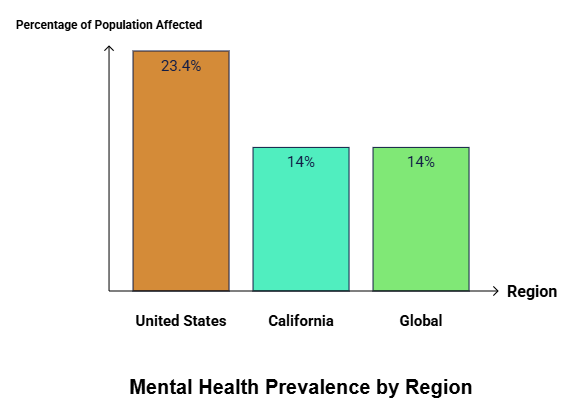
| Region | Population Affected |
| United States | 23.4% of adults |
| California | ~14% of adults |
| Global | ~14% of all people (1 in 7) |
Sourced By: ourworldindata.org
Most Common Mental Health Conditions
Anxiety disorders, depression, PTSD, ADHD, bipolar disorder, OCD, and eating disorders make up the majority of diagnosed conditions across age groups, though prevalence and presentation shift with age.
| Condition | Adults | Children | Teens |
|---|---|---|---|
| Anxiety | 19.1% | Common, often under-diagnosed | Rising, frequently comorbid with depression |
| Depression | ~8-9% annual major depressive episode | Less common but increasing | 18.1% major depressive episode (12-17) |
| PTSD | ~3.6% annual prevalence | Linked to trauma exposure | Elevated after abuse, violence, or loss |
| ADHD | ~4.4% adult lifetime | ~9-10% diagnosed | Frequently continues from childhood |
| Bipolar Disorder | ~2.8% annual prevalence | Rare, onset often in adolescence | Onset frequently begins here |
| OCD | ~1.2% annual prevalence | Can begin in childhood | Symptoms often intensify |
| Eating Disorders | Affects millions, often underreported | Onset can begin before age 12 | Highest risk period for onset |
Anxiety responds well to structured approaches like cognitive behavioral therapy and exposure-based work. Depression often improves with a combination of talk therapy and, when appropriate, medication management. Trauma and PTSD frequently respond to trauma-focused modalities such as EMDR therapy and Brainspotting therapy, which target how traumatic memories are stored and processed rather than only addressing symptoms. None of these approaches work identically for everyone, and a licensed therapist typically adjusts the plan based on how a person responds over the first several sessions.
Why Mental Health Cases Are Increasing
Several converging pressures explain the rise in reported cases rather than any single cause. Social isolation has been intensified by the shift to remote work, a decline in face-to-face community engagement, and has diminished people’s informal support networks. This, coupled with financial stress and work-related stress, is a particular issue for young adults under 35 years old, who are most likely of all adult age groups to report a mental illness.
There is a link between social media and increased anxiety and depression symptoms for teens, although whether it is reflective of larger trends or cause is debatable. Include chronic trauma exposure, escalating drug use, and newfound climate-related stress, and the uptick begins to make sense. Genuine progress can be attributed to some of the increase: screening has improved, stigma has reduced a little, and there’s been an increase in people recognizing and reporting symptoms which previous generations minimized or ignored.
Mental Health Treatment Gap
Prevalence and treatment access are two different problems, and the gap between them is the defining issue in mental health care today. Nationally, just 43% of U.S. adults with a mental illness used any treatment in the past year. The situation is even more dire among adolescents: Estimates are that 70-80% of adolescents with a diagnosable mental health problem do not get professional treatment, and only 19-20% of teens with depression get treatment of adequate quality.
The barriers are consistent across every dataset reviewed here: cost, cited by 52% of Americans as the top obstacle, difficulty finding an available provider, cited by 42%, and a therapist shortage that leaves more than 120 million Americans living in a designated shortage area. Counties in rural areas have the largest disparities, and sometimes must turn to telehealth in order to cross the distance that would otherwise require hours of driving for a single appointment. Insurance network adequacy is another ongoing issue, as well: Over half of California’s adults (50%) say they have difficulty finding an in-network mental health provider, versus 14% of adults in a physical health care provider.
When to Seek Professional Help
Persistent anxiety that interferes with sleep, work, or relationships is a signal worth acting on, not waiting out. This is true for symptoms of depression persisting for at least two weeks, sharp shifts in mood, problems with functioning in daily life, or symptoms of trauma such as flashbacks, avoidance, and hypervigilance. None of these have to be in crisis before treatment is appropriate. The earlier in intervention, the quicker the relief and the sooner the therapy time.
If anything of this sounds familiar, then licensed clinicians at Lumen Health Services are available to offer individual therapy, child therapy, teen therapy, anxiety therapy, and depression therapy – all based on what you’re going through rather than a one-size-fits-all approach.
The Bottom Line
Mental illness affects roughly 1 in 4 American adults, 1 in 3 American teens, and more than 1 billion people worldwide, yet treatment remains out of reach for the majority who need it. The data is consistent across NIMH, SAMHSA, CDC, CHCF, and WHO sources: prevalence is high, the treatment gap is wide, and cost and provider shortages remain the two biggest barriers standing between people and care.
At Lumen Health Services, our licensed therapists work directly with these realities every day, offering anxiety therapy, depression therapy, trauma therapy, EMDR therapy, and Brainspotting therapy for individuals, couples, and families across California and via online therapy nationwide.
If you recognize any of these patterns in yourself or someone you love, reach out to schedule a consultation with Lumen Health Services today. Support is available, and starting the conversation is the hardest part.
FAQ’s
23.4% of U.S. adults, about 61.5 million people, experienced a mental illness in 2024, according to SAMHSA’s National Survey on Drug Use and Health.
Anxiety disorders are the most common, affecting 19.1% of U.S. adults annually, according to NIMH.
Roughly 1 in 3 adolescents ages 12 to 17 had a mental, emotional, or behavioral condition in 2022-2023, based on SAMHSA data.
Rankings shift year to year depending on the survey, but Western and Appalachian states typically report higher rates than the national average. California’s adult prevalence rate has recently tracked close to or slightly below the national average, based on 2022-2023 survey data.
More than 1 billion people globally, about 1 in 7, live with a mental disorder, according to the World Health Organization’s 2025 data.
About 43% of adults with a mental illness received treatment in the past year, and treatment rates for both adults and adolescents declined slightly between 2023 and 2024, according to SAMHSA.
Reported prevalence has been statistically stable since 2021 for adults, though raw numbers have grown with population size. Youth rates have shown early signs of leveling off after several years of increase.
Also Read: