
Couples therapy can improve communication by helping partners recognize unhealthy interaction patterns, listen without immediately becoming defensive, express their needs more clearly, and handle disagreements in healthier ways. A couples therapist can provide structure when conversations repeatedly turn into arguments, avoidance, or emotional withdrawal. Therapy does not mean couples must stop disagreeing. Instead, it can help partners learn how to discuss difficult issues, understand each other’s perspectives, and work through conflict more constructively.
How Does Couples Therapy Improve Communication?
Couples therapy gives partners a structured setting to understand what happens during difficult conversations and practice different ways of responding. Instead of focusing only on the subject of an argument, the therapist can help identify the communication pattern underneath it.
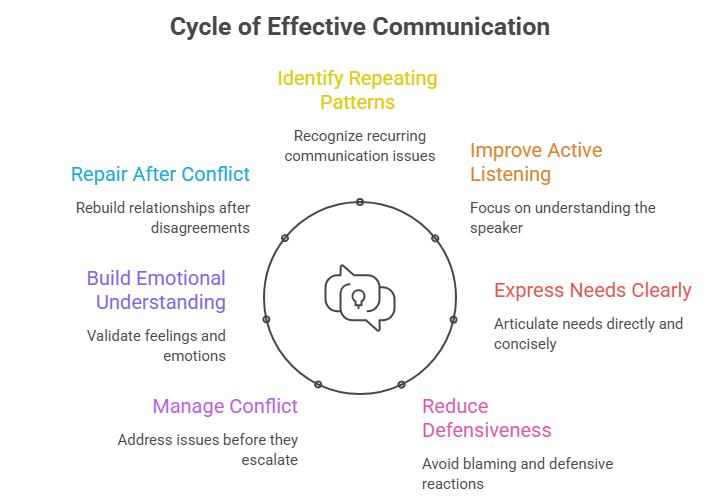
Identifying Repeating Communication Patterns
Many couples have the same argument repeatedly, even when the topic changes. One partner may criticize while the other becomes defensive. One may continue asking for reassurance while the other withdraws.
A therapist can help couples recognize these patterns and understand how each person’s response affects the other. Once the pattern becomes clearer, couples can begin practicing different responses.
Learning to Listen Without Immediately Reacting
Good communication is not just about listening and talking when it is your turn. Partners should be able to decipher the other person’s communications.
Listening, active and reflective listening are forms of therapy. One partner explains their concern while the other summarizes what they heard before responding. This can help minimize confusion and allow for both parties to clear up any misunderstandings before they occur.
Expressing Needs More Clearly
Couples sometimes communicate frustration through criticism, accusations, or general statements.
For instance, the words ‘You never listen to me’ may make a partner feel they are being attacked. For instance, instead of saying, “I feel ignored when I’m talking, you’re looking on your phone,” you might say, “I feel ignored when I’m talking, you’re looking at your phone.”
A therapist can assist couples to rephrase their criticism into more specific requests and express emotions without fault.
Managing Conflict Before It Escalates
Feelings can build up and make it more difficult to communicate. Partners can talk over one another, get louder, or become defensive, or they may stop talking.
Couples therapy can help couples learn how to identify escalation and to implement strategies to defuse the conversation. This can include a formal “time out” or returning to the discussion at a predefined time and addressing one question rather than multiple topics of contention.
What Communication Problems Can Couples Therapy Help With?
Couples therapy may help when communication problems are affecting trust, emotional connection, or the ability to resolve everyday disagreements.
Common concerns include:
Frequent Arguments About the Same Issues
Other couples also have a tendency to continually fight over finances, parenting, household chores, bedroom boundaries, time together, or intimacy without ever finding a resolution that lasts.
Therapy can be used to create a more productive communication pattern around the disagreement and to find a new way to communicate about the underlying issue.
Feeling Unheard or Misunderstood
Other couples also have a tendency to continually fight over finances, parenting, household chores, bedroom boundaries, time together, or intimacy without ever finding a resolution that lasts.
Therapy can be used to create a more productive communication pattern around the disagreement and to find a new way to communicate about the underlying issue.
Defensiveness and Blame
Defensiveness can quickly turn a conversation into an argument. When one partner feels Defensiveness can quickly turn a conversation into an argument. If one partner feels criticized, they will be more likely to defend themselves than to understand the concern.
A therapist can assist couples in recognizing these responses and learning to communicate in a way that doesn’t attack, but focuses on the issue.
Emotional Withdrawal or Avoidance
Some couples in trouble, avoid facing conflicts. While it’s okay to take a break from things to cool down, if you keep avoiding important topics then you’re leaving issues unresolved.
Couples can learn to engage in challenging conversations in safer, more structured ways through therapy.
What Communication Techniques Are Used in Couples Therapy?
The specific techniques depend on the couple’s concerns, treatment goals, and therapist’s approach. Actively listening, validation, clear requests, emotional-regulation and structured conflict-resolution are all common communication strategies.
Active and Reflective Listening
Active listening means paying attention to the speaker rather than preparing a defense or response.
Reflective listening adds another step. The listening partner summarizes what they understood and gives the speaker an opportunity to correct or clarify the message.
This approach can reduce the assumption that both partners already understand what the other person means.
Using “I” Statements
“I” statements can help partners describe their feelings and experiences without making broad accusations.
For example:
“I feel disconnected when we do not have time to talk.”
This communicates a concern more specifically than a statement such as “You do not care about me.”
The goal is not to avoid difficult feelings. It is to communicate them in a way that gives the other person an opportunity to respond.
Validation
Validation means acknowledging that a partner’s feelings or perspective make sense from their point of view. It does not require agreeing with every statement.
For example, a partner might say, “I understand why that situation made you feel ignored, even though I experienced it differently.”
This can help reduce the need for each person to prove that their perspective is the only correct one.
Structured Conflict Resolution
A therapist can assist couples to temporarily defuse a conflict and concentrate on a single issue.
The dialogue could involve stating the issue, clarifying each person’s view, outlining each person’s needs, and brainstorming solutions.
This can help to make difficult conversations easier to manage and also help to limit the chances of letting old issues creep into the conversation.
Repair and Reconnection
While healthy communication does not imply that couples never hurt each other’s feelings, it does mean that there are ways to avoid doing so. Handle issues as they arise when communication fails.
A repair attempt can be an acknowledgement, apology, explanation of a plan to do something differently, recognition of a partner’s experience, or returning to a conversation when emotions have settled.
Why Do Couples Keep Having the Same Communication Problems?
Feelings of fairness, appreciation, trust or emotional support may also be involved in a disagreement about household responsibilities.
Communication can be automatic, too. One partner might want reassurance, the other does not because they feel overwhelmed. This withdrawal can then cause the first partner to feel more anxious, resulting in more pursuit.
Couples will be able to recognize the patterns with the help of therapy instead of dealing with each disagreement as a distinct issue.
How partners communicate with each other can also be affected by stress, unhealed relationship wounds, differences in expectations, emotional requirements, and acquired communication patterns.
Can Couples Therapy Help If Communication Has Completely Broken Down?
Couples do not need to have good communication before beginning therapy.
Treatment can be helpful if there are issues communicating without conflict, if there is avoidance of significant topics, if there is a lack of emotional connection with partner, or if there is frequent misunderstanding.
The therapist can offer structure and assist partners to communicate at a more manageable rate.
But the couples therapy doesn’t assure that the relationship will be salvaged or that all disagreements will be resolved. Treatment progress is dependent upon treatment concerns, treatment goals, participation, and the practice of new communication skills outside of sessions.
What Should Couples Expect From Therapy?
Understanding the therapy process can make the decision to seek help easier.
Initial Assessment
The therapist usually begins by learning about the relationship, current concerns, communication difficulties, relevant history, and the couple’s goals.
Identifying the Communication Cycle
The therapist observes how partners interact and helps identify patterns that may be maintaining conflict or emotional distance.
Practicing New Communication Skills
Couples may practice listening, validation, emotional expression, problem-solving, and conflict-management strategies during sessions.
Applying Skills Between Sessions
Communication skills become more useful when couples practice them in everyday situations. Couples may be encouraged to use specific strategies between appointments.
Reviewing Progress
Therapy is adjusted as the couple’s needs change. Some couples may focus on communication first, while others may need to address trust, intimacy, family concerns, or other relationship difficulties.
How Long Does It Take to Improve Communication in a Relationship?
There is no fixed timeline for improving communication.
Progress can depend on how long the problems have existed, the level of relationship distress, the willingness of both partners to participate, and whether other concerns are affecting the relationship.
Research supports the effectiveness of couple therapy for several relationship outcomes. A meta-analysis of 58 studies involving 2,092 couples found significant improvements in relationship satisfaction, communication, emotional intimacy, and partner behaviors following couple therapy. Results varied between couples, so these findings should not be interpreted as a guarantee of a specific outcome or timeline.
When Should You Consider Couples Therapy for Communication Problems?
You may want to consider couples therapy if:
- The same arguments keep happening without resolution.
- Conversations regularly become defensive or hostile.
- One or both partners feel consistently unheard.
- Important subjects are repeatedly avoided.
- You struggle to resolve disagreements on your own.
- Emotional distance is increasing.
- Communication problems are affecting trust or intimacy.
- You have tried communication strategies but cannot maintain the changes.
Couples do not have to wait until a relationship reaches a crisis before seeking professional support.
Can Couples Improve Communication Without Therapy?
Some couples can benefit from practicing communication skills independently.
Active listening, specific requests, “I” statements, regular check-ins, validation, and taking appropriate breaks during escalating disagreements can provide a useful starting point.
However, self-guided strategies may be difficult to apply when partners repeatedly fall into the same conflict cycle or cannot have productive conversations without escalation.
A couples therapist can provide professional guidance, identify patterns that may be difficult to recognize independently, and help partners practice new communication skills in a structured setting.
What Does Research Say About Couples Therapy and Communication?
Research supports several forms of couple therapy for relationship distress and communication-related concerns.
A meta-analysis published in 2020 found that couple therapy produced significant improvements in relationship satisfaction, communication, emotional intimacy, and partner behavior.
Research reviews have also examined behavioral and emotion-focused approaches to couple therapy, with findings showing benefits for many couples while also highlighting variation in treatment response.
Another qualitative meta-analysis found that clients commonly described improvements in communication quality, relationship functioning, and conflict management following couple therapy.
These findings support couples therapy as an evidence-based treatment option, while also showing why treatment should be tailored to the individual couple.
Improve Communication With Lumen Health & Psychological Services
Better communication is not simply about talking more. It involves learning how to listen, express concerns clearly, manage difficult emotions, and respond differently when familiar conflict patterns appear.
If communication problems are creating repeated conflict or emotional distance in your relationship, professional support can help you understand what is happening and work toward healthier communication.
Lumen Health & Psychological Services provides therapy for couples and families experiencing relationship and communication concerns. If you are unsure whether couples therapy is right for your situation, speaking with a qualified therapist can help you understand your options.
Conclusion
Communication problems can affect trust, emotional connection, and the ability to resolve everyday relationship challenges. Couples therapy provides a structured environment where partners can identify recurring patterns, practice healthier communication skills, and learn more constructive ways to manage conflict.
The goal is not to eliminate every disagreement. It is to help partners communicate through disagreements with greater clarity, understanding, and respect.
If communication has become difficult in your relationship, Lumen Health & Psychological Services can help you explore appropriate therapy options and take the next step toward healthier communication.
FAQ’s
Couples therapy helps partners recognize unhealthy communication patterns, practice active listening, express needs more clearly, manage emotional reactions, and resolve disagreements more constructively.
Yes. Communication problems are a common reason couples seek therapy. Treatment can help partners understand recurring patterns, improve listening, communicate needs, and develop healthier approaches to conflict.
A therapist typically learns about the couple’s concerns, identifies communication patterns, teaches relevant skills, and provides opportunities to practice those skills during sessions and between appointments.
Couples therapy cannot guarantee that disagreements will stop. It can help partners understand what drives recurring conflict and develop healthier ways to discuss disagreements and repair communication after conflict.
One partner can begin individual therapy to discuss relationship concerns and learn communication strategies. If the other partner becomes comfortable with therapy later, couples sessions may become an option.
The timeline varies. It can depend on the severity and duration of the communication problems, treatment goals, participation, and other relationship concerns.
There is no single technique that works for every couple. Active listening, validation, clear requests, emotional regulation, and structured conflict resolution can all be useful depending on the couple’s needs.
Improving communication can make it easier for partners to understand each other’s feelings, needs, and experiences. For some couples, this can support greater emotional connection and intimacy.
Also Read:
Types of Couples Therapy Explained
How Relationship Therapy Helps Couples
72-Hour Rule in Marriage: A Therapist’s Guide
How Much Does Couples Therapy Cost?