

Rules for couples counseling help partners communicate respectfully, understand each other’s concerns, and work through relationship challenges in a structured environment. The following guidelines serve as expectations for listening, honesty, confidentiality, emotional boundaries, and participation. Following clear ground rules for couples therapy can make sessions more productive and help both partners focus on meaningful relationship changes.
Couples counseling is not about deciding who is right or wrong. Provides partners the chance to learn about recurring conflicts, notice unhealthy communication patterns, and learn healthier ways to react to each other.
Why Are Ground Rules Important in Couples Counseling?
Discussions around relationships can be emotional, particularly when talking about trust, conflict, intimacy, money or past issues. If you don’t have clear expectations, conversations could escalate into arguing rather than discussion.
Ground rules establish a respectful framework of respect, no personal attacks, no judgment, and no interruptions from both sides.
Couples therapy can be done in various ways, including Emotionally Focused Therapy (EFT), the Gottman Method, or Cognitive Behavioral Therapy (CBT), depending on the couples’ needs and clinical evaluation. These methods can be useful for partners to learn about their own emotional tendencies, communication and healthier ways of reacting.
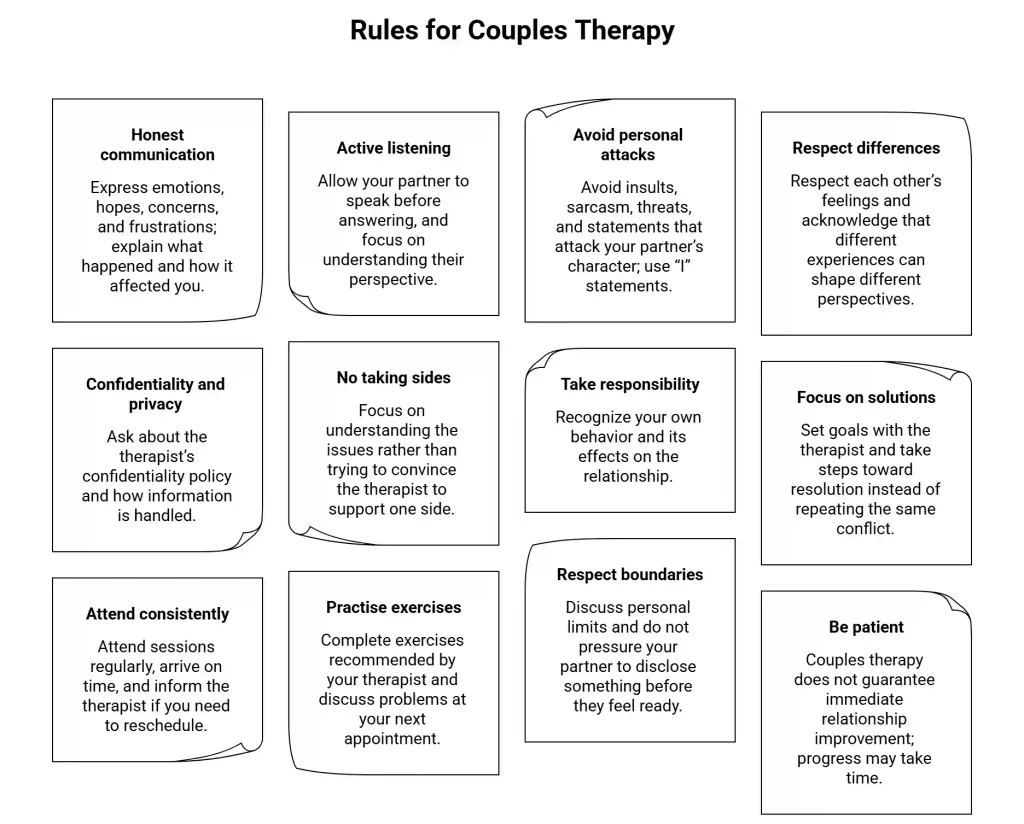
12 Essential Rules for Couples Therapy
1. Be Honest and Open About Your Feelings
Being honest helps couples discuss issues that matter to them. Partners must express their emotions, hopes, concerns, and frustrations, not ignore huge issues.
For example, instead of saying, “Everything is fine,” when something feels wrong, explain what happened and how it affected you. Honest communication enables the therapist to better understand the difficulties in the relationship and what treatment goals are appropriate.
2. Listen Without Interrupting Your Partner
Active listening is an important part of couples counseling. Allow partner to speak his or her mind before answering.
Do not give a defensive reply while your partner is talking. Instead, focus on understanding their perspective. It’s possible to also restate what you heard to make sure you have interpreted their concern accurately.
3. Avoid Blaming, Criticism, and Name-Calling
Personal attacks can make difficult conversations more damaging. Avoid insults, sarcasm, threats, and statements that attack your partner’s character.
Use “I” statements to explain your experience. For example, say, “I feel disconnected when we do not spend time together,” rather than, “You never care about this relationship.”
This approach focuses on feelings and specific concerns instead of assigning blame.
4. Respect Each Other’s Opinions and Emotions
Partners do not need to agree on every issue. However, they should respect each other’s feelings and acknowledge that different experiences can shape different perspectives.
Avoid dismissing your partner by calling their concerns unreasonable or unimportant. A therapist can help both partners discuss disagreements without treating differences of opinion as personal attacks.
5. Understand Confidentiality and Privacy
Couples counseling involves sensitive personal and relationship information. Partners should be aware of how the therapist safeguards information and understand the potential for legal or professional exceptions.
Ask the therapist about their confidentiality policy, including how they handle individual conversations, private disclosures, clinical records, and information shared outside joint sessions.
Remember that there are no guarantees of confidentiality in the event of any circumstance. Professional standards and laws must be adhered to by therapists.
6. Do Not Expect the Therapist to Choose Sides
A couples therapist does not act as a judge who decides which partner is right. The therapist helps identify relationship patterns, communication difficulties, and individual concerns that affect the relationship.
However, neutrality does not mean ignoring harmful behavior. A therapist should address intimidation, abuse, coercion, and safety concerns appropriately.
Both partners should focus on understanding the issues rather than trying to convince the therapist to support one side.
7. Take Responsibility for Your Own Actions
Improving a relationship requires each partner to recognize their own behavior and its effects. Avoid focusing entirely on what your partner needs to change.
Think about how your reactions, communication habits, or expectations contribute to recurring disagreements. Taking responsibility does not mean accepting blame for behavior you did not cause or sharing responsibility equally for abuse.
8. Focus on Solutions Instead of Repeating Arguments
Talking about the things that have happened in the past can assist in understanding today’s relationship issues. But if you continue to revisit the same conflict without taking steps toward resolution, change may be hard to come by.
Collaborate with therapist to set goals. These can involve better communication, establishing boundaries, rebuilding trust or finding new ways to manage conflict.
9. Attend Sessions Consistently and Arrive on Time
Regular attendance helps couples maintain continuity and work toward their treatment goals. Arrive on time, prepare to participate, and inform the therapist if you need to reschedule.
If one partner frequently misses appointments, discuss the reasons openly. Work schedules, emotional discomfort, financial concerns, and uncertainty about therapy may affect participation.
10. Practise Therapy Exercises Between Sessions
Relationship changes require practice outside the therapist’s office. Your therapist might recommend exercises for communicating, check-ins on feelings or connection-building activities.
For example, partners might schedule time to discuss concerns without distractions or practise listening before responding.
Complete any exercises that your therapist prescribes and discuss any problems at your next appointment.
11. Respect Personal Boundaries
Healthy relationships require respect for individual needs, privacy, and personal limits. Couples should discuss boundaries involving communication, personal space, family relationships, finances, and digital privacy.
Do not pressure your partner to disclose something before they feel ready. A therapist can help both partners discuss boundaries and understand how to respect them.
12. Be Patient With the Counseling Process
Couples therapy does not guarantee immediate relationship improvement. The process of progress is influenced by many factors, such as the concerns at issue, whether each partner participates, the desired outcome for treatment, and the appropriateness of the therapeutic approach.
For some couples, the improvements in communication come first before working through more profound concerns. Some might require more time to grasp the routines and learn the new habits.
Talk with your therapist about how you are doing and make any necessary changes to goals.
What Are the Rules for a Couples Therapist?
A couples therapist also has professional responsibilities. These include:
- Maintaining professional boundaries: The therapist should establish a clear professional relationship with everyone participating in treatment.
- Explaining confidentiality: Partners should understand privacy protections and their legal and professional limitations.
- Avoiding favoritism: The therapist should not allow personal opinions to determine which partner receives support.
- Establishing treatment goals: The therapist should help partners identify realistic goals based on their concerns.
- Protecting client welfare: The therapist should assess safety concerns and determine whether joint counseling is clinically appropriate.
The American Psychological Association and the California Association of Marriage and Family Therapists provide professional guidance on ethical responsibilities, confidentiality, informed consent, and therapy involving multiple people.
What Should Couples Avoid During Couples Therapy?
Partners should avoid behaviors that make productive communication difficult, including:
- Interrupting or talking over each other.
- Using insults, threats, or humiliating language.
- Bringing up unrelated arguments to win a disagreement.
- Dismissing a partner’s feelings.
- Expecting the therapist to decide who is right.
- Pressuring a partner to agree with every statement.
- Treating therapy as a way to punish or control the other person.
If emotions become overwhelming, the therapist may pause the conversation and help both partners regulate their responses before continuing.
Can Couples Therapy Help When One Partner Refuses to Participate?
Yes, there may still be ways to address relationship concerns when one partner feels hesitant about counseling. However, a therapist cannot force someone to participate.
The willing partner can discuss their concerns, explore individual patterns, and consider appropriate next steps. If both partners eventually agree to attend, the therapist can assess their needs and determine whether joint sessions are suitable.
When Is Couples Therapy Not Appropriate?
Couples therapy is not suitable for every relationship situation. When a relationship involves coercive control, intimidation, or ongoing intimate partner violence, joint sessions may create additional risks.
A qualified professional should assess safety before recommending joint treatment. Depending on the circumstances, separate support, individual services, safety planning, or specialized domestic violence resources may be more appropriate.
Research published in the American Psychological Association’s journal Practice Innovations highlights the importance of assessing intimate partner violence before beginning couples-based treatment.
Build Healthier Communication With Couples Counseling
Following the rules for couples counseling can help partners approach difficult conversations with greater respect, honesty, and understanding. However, ground rules alone cannot resolve every relationship concern. Couples can improve communication, find healthier patterns and set realistic goals with the help of professional guidance.
Lumen Health & Psychological Services provides couples therapy to help partners address relationship challenges and improve communication. The therapist can work with couples to understand their concerns and identify an appropriate treatment approach.
If communication difficulties, recurring disagreements, or emotional distance are affecting your relationship, consider taking the next step.
Contact Lumen Health & Psychological Services to learn more about professional couples therapy and available support.
FAQ’s
The basic rules include honest communication, respectful listening, avoiding personal attacks, understanding confidentiality, respecting boundaries, and participating consistently in treatment.
The 12 ground rules include honesty, active listening, avoiding blame, respecting emotions, understanding confidentiality, avoiding favoritism, accepting personal responsibility, focusing on solutions, attending sessions, practising exercises, respecting boundaries, and remaining patient.
Avoid insults, threats, humiliation, dismissive comments, and statements intended to control or shame your partner. Explain your concerns through specific examples and respectful language.
Therapists protect client information under applicable laws and professional standards. However, confidentiality has exceptions, and policies for individual disclosures during couples treatment can differ. Ask your therapist to explain these policies before sharing sensitive information.
A therapist should avoid favoritism and help partners understand relationship patterns. However, the therapist should not ignore abuse, coercion, intimidation, or other harmful behavior.
Both partners should have meaningful opportunities to express their concerns. Equal participation does not always mean speaking for exactly the same amount of time. The therapist may structure conversations according to each partner’s needs.
Yes. Couples counseling can support dating, engaged, married, and long-term unmarried partners. Relationship concerns, rather than marital status, guide the counseling process.
There is no fixed timeline. Some couples notice changes in communication within a few sessions, while deeper relationship concerns may require longer treatment. Progress depends on individual circumstances and treatment goals.