Family conflicts are a normal part of life, but ongoing communication problems, parenting challenges, or emotional stress can affect every member of the household. Family therapy helps families understand these patterns, strengthen relationships, and develop healthier ways to communicate. Whether you’re dealing with parent-child conflict, relationship issues, anxiety, or life transitions, the right family therapy approach can help your family move forward together.
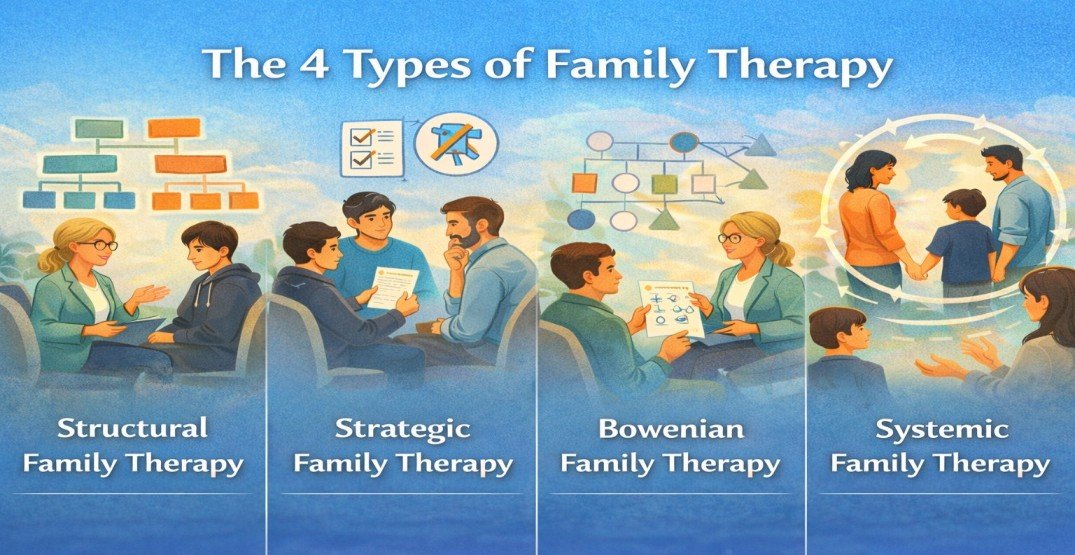
The four most widely recognized types of family therapy are Structural Family Therapy, Strategic Family Therapy, Bowenian Family Therapy, and Systemic Family Therapy. Each approach focuses on different aspects of family relationships and is designed to address specific challenges.
If you’re looking for a family therapist near you or want to understand which therapy model may be right for your family, this guide explains the most common family therapy modalities, how they work, and when they are most effective.
Why Choose Family Therapy?
Family therapy is different from individual therapy because it treats the family as a whole unit of treatment, not just the family member or members. It understands that the thought, emotions and actions of each member of the family impact the whole family. Communication, relationship dynamics and unhealthy behaviors are examined holistic and family therapy supports families in strengthening the relationship and settling conflicts.
It can help with many issues including parent and child conflict, marriage and relationship difficulties, divorce and separation, blended family issues, adolescent behaviour problems, anxiety, depression, trauma, loss, substance use recovery and significant life changes.
The aim is to foster a more positive and nurturing family dynamic, where everyone feels heard, understood, and empowered to support each other through difficult times.
Research from the American Association for Marriage and Family Therapy (AAMFT) shows that most clients report improvements in family relationships and emotional health after therapy. The National Institute of Mental Health (NIMH) also recognizes that strong family support plays an important role in recovery from many mental health conditions.
What Is Family Therapy?
Family conflicts are a normal part of life, but ongoing communication problems, parenting challenges, or emotional stress can affect every member of the household. Family therapy is one way to help families identify these patterns, improve bonds, and learn alternative communication skills. There are a variety of family therapy methods available that can assist your family to get on the same page during parent-child conflict, relationship struggles, anxiety, and life changes.
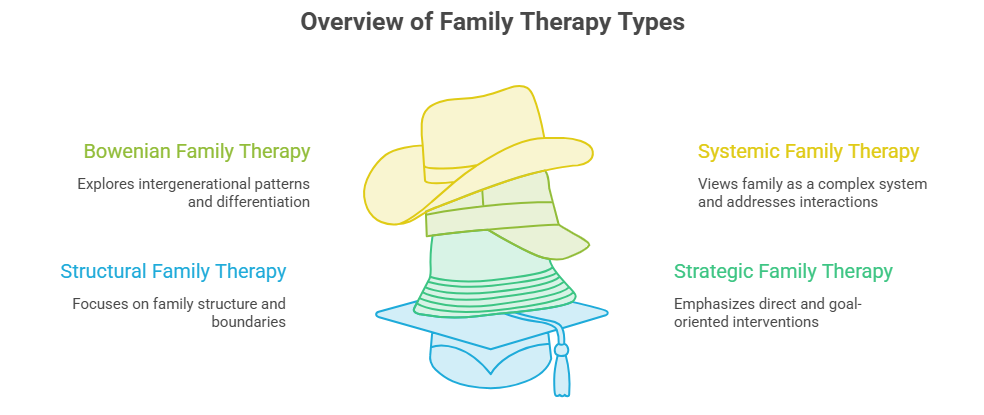
The four most widely recognized types of family therapy are:
- Structural Family Therapy
- Strategic Family Therapy
- Bowenian Family Therapy
- Systemic Family Therapy
These approaches work on different areas of family relations and are targeted at particular issues.
If you’re looking for a family therapist near you or want to understand which therapy model may be right for your family, this guide explains the most common family therapy modalities, how they work, and when they are most effective.
Family Therapy Approaches, Models, and Modalities
Many people search for family therapy approaches, family therapy models, and family therapy modalities. Although these terms are often used interchangeably, they have slightly different meanings.
Family therapy approaches describe the overall treatment philosophy.
Family therapy models refer to established theoretical frameworks developed by experts.
Family therapy modalities are the specific techniques therapists use during treatment.
Structural, Strategic, Bowenian, and Systemic Family Therapy are considered four of the most influential family therapy models used by licensed mental health professionals today.
1. Structural Family Therapy (Best for Family Roles and Boundaries)
Structural Family Therapy is developed by Dr. Salvador Minuchin that emphasizes the relationship between family members in terms of roles, boundaries, and hierarchies. Dyads can have trouble functioning because boundaries are set too high or too low, which can challenge parent-child relationships.
Throughout the course of therapy, the therapist watch how the family members communicate and interact with each other. They can invite family members to role-play familiar scenarios to recognize unhealthy behaviors and learn healthier ones.
Common Techniques
- Joining with the family
- Enactments
- Boundary setting
- Family restructuring
- Strengthening parental leadership
Best For
- Parent-child conflict
- Divorce
- Blended families
- Behavioral problems
- Family conflict
- Chronic illness affecting family roles
Example
A teenager regularly argues with parents and ignores household rules because family boundaries are unclear. Through Structural Family Therapy, parents learn to establish consistent expectations while improving communication and reducing conflict.
Benefits
- Creates healthier family roles
- Improves communication
- Reduces power struggles
- Builds stronger parent-child relationships
Most treatment plans involve approximately 10 to 20 sessions, although the exact duration depends on each family’s needs.
2. Strategic Family Therapy (Best for Changing Behaviors Quickly)
Strategic Family Therapy was developed by Jay Haley and is concerned with problem solving in the present, not in the past. Therapists develop a structure of interventions to stop negative patterns and promote positive change.
Families are given quick assignments to be worked on between sessions rather than lengthy discussions. These are strategies that can be used to help families establish more healthy routines and to help them to improve their problem solving skills.
Common Techniques
- Homework assignments
- Reframing problems
- Directives
- Paradoxical interventions
- Behavior-focused strategies
Best For
- Teen rebellion
- School-related issues
- Frequent family arguments
- Crisis situations
- Parenting challenges
Example
Parents struggling with a defiant teenager receive structured communication exercises that reduce daily arguments while encouraging consistent parenting strategies.
Benefits
- Goal-oriented treatment
- Faster behavioral improvements
- Practical strategies families can use immediately
- Short-term treatment, often 6 to 12 sessions
3. Bowenian Family Therapy (Best for Generational Patterns)
Bowenian family therapy, developed by psychiatrist, Dr. Murray Bowen, examines how emotional patterns are transmitted from generation to generation. This rather than just examining the present conflicts, assists individuals in comprehending how family history affects existing relationships.
The genogram, a comprehensive family tree diagram illustrating hierarchical, emotional, mental health, and life events over several generations, is one of its most effective tools.
Common Techniques
- Genograms
- Coaching
- Differentiation of self
- Detriangling
- Emotional awareness
Best For
- Chronic anxiety
- Family stress
- Emotional dependency
- Relationship conflicts
- Repeated generational patterns
Example
An adult repeatedly experiences conflict with parents and partners. Through Bowenian therapy, they recognize inherited communication patterns and develop healthier emotional boundaries.
Benefits
- Improves emotional resilience
- Breaks unhealthy family cycles
- Strengthens personal independence
- Encourages healthier long-term relationship
4. Systemic Family Therapy (Best for Understanding Relationship Patterns)
Systemic Family Therapy views the family as an interconnected system where each person’s thoughts, emotions, and behaviors influence everyone else. This isn’t so much about pointing fingers at the other person as it is about understanding the nature of the relationship that can be the source of conflict.
Circular questioning is a widely used technique by therapists to ask questions in a way that causes other family members to consider how they may be impacting each other and cultivates empathy and cooperation.
Common Techniques
- Circular questioning
- Reframing
- Positive connotation
- Collaborative problem-solving
- Communication exercises
Best For
- Communication difficulties
- Parent-child conflict
- Couples experiencing family stress
- Blended families
- Ongoing relationship challenges
Example
Parents believe their teenager is the source of family tension. Through Systemic Family Therapy, they discover that inconsistent communication and stress within the household are contributing to everyone’s frustration. By improving communication, the entire family begins working together more effectively.
Benefits
- Strengthens communication
- Improves teamwork
- Builds empathy
- Helps families solve problems together
- Supports lasting relationship changes
Schools of Family Therapy
Over the years, mental health professionals have developed several schools of family therapy, each offering a different perspective on understanding family relationships.
The most recognized schools include:
- Structural Family Therapy: Focuses on family roles, hierarchies, and healthy boundaries.
- Strategic Family Therapy: Uses structured interventions to change unhealthy behaviors.
- Bowen Family Systems Theory: Examines emotional patterns passed across generations.
- Systemic Family Therapy: Explores interaction patterns within the family system.
- Narrative Family Therapy: Helps families separate themselves from problems and rewrite unhealthy narratives.
- Solution-Focused Family Therapy: Concentrates on strengths, goals, and practical solutions rather than past difficulties.
Each approach can be effective depending on your family’s unique circumstances. A licensed family therapist will recommend the most appropriate treatment model after a comprehensive assessment.
Structural Family Therapy vs. Strategic Family Therapy
One of the most common questions people ask is whether Structural Family Therapy or Strategic Family Therapy is better.
| Structural Family Therapy | Strategic Family Therapy |
| Focuses on family structure and boundaries | Focuses on changing specific behaviors |
| Addresses long-term relationship patterns | Solves immediate problems |
| Strengthens family roles | Uses homework and practical assignments |
| Best for ongoing family dynamics | Best for short-term behavioral concerns |
| Typically 10–20 sessions | Typically 6–12 sessions |
Neither approach is better for every family. The right choice depends on your family’s needs, goals, and the guidance of a licensed therapist.
What Is Family Systems Therapy?
Family Systems Therapy is a therapeutic technique that takes a more holistic approach to the problem than treating it as something that is just one family member’s issue.
It’s founded on the concept that each family member’s ideas, emotions and behaviors effect the entire family system. Instead of asking, “Who caused the problem?”, family systems therapy explores how relationship patterns, communication styles, and emotional responses contribute to ongoing challenges.
Through this, the therapy encourages better communication, deeper emotional bond, improved coping mechanisms and joint problem-solving with family members. As time goes on, this process can strengthen the bond between family members and provide them with long-term strategies to resolve conflicts and cope with life’s difficult situations more effectively.
Family Therapy vs. Family Counseling
Many people use family therapy and family counseling interchangeably. While they are similar, there are slight differences.
| Family Counseling | Family Therapy |
| Often focuses on current challenges | Explores emotional and behavioral patterns |
| Usually short-term | May be short or long-term |
| Supports communication and conflict resolution | Treats relationship and mental health concerns |
| Educational and supportive | Clinical psychotherapy provided by licensed professionals |
Whether you search for family counseling near me or family therapy near me, the most important factor is choosing a qualified mental health professional who understands your family’s needs.
Online Family Therapy
Many families now choose online family therapy because it offers greater flexibility and makes it easier for family members to attend sessions from different locations. Secure video sessions can be especially helpful for parents, children, or relatives who cannot easily travel to the same office.
Online family therapy may be a convenient option for families with busy schedules, members who live in different cities, those who prefer receiving therapy from home, people who need more flexible appointment times, or families who have limited access to in-person mental health services.
Research supported by the Substance Abuse and Mental Health Services Administration (SAMHSA) recognizes telebehavioral health as an effective way to improve access to mental health services for many individuals and families.
4 Types of Family Therapy: Quick Comparison
| Therapy Type | Main Focus | Best For | Typical Sessions |
| Structural Family Therapy | Roles and boundaries | Divorce, parenting issues, family conflict | 10–20 |
| Strategic Family Therapy | Changing behaviors | Teen behavior, crisis situations | 6–12 |
| Bowenian Family Therapy | Generational patterns | Anxiety, emotional dependency | Varies |
| Systemic Family Therapy | Relationship interactions | Communication problems, family dynamics | Varies |
Does Family Therapy Really Work?
Research consistently shows that family therapy improves communication, emotional well-being, and relationship satisfaction.
According to the American Association for Marriage and Family Therapy (AAMFT):
- Nearly 90% of clients report improvements in emotional health after therapy.
- More than 98% rate therapy services as good or excellent.
- Most clients report better family functioning after treatment.
The National Institute of Mental Health (NIMH) also emphasizes that supportive family relationships can improve outcomes for people living with anxiety, depression, and other mental health conditions. Additionally, SAMHSA recommends family-based interventions as evidence-based approaches for improving behavioral health outcomes in children, adolescents, and adults.
Conclusion
Family therapy can help families understand unhealthy patterns, improve communication, and build stronger relationships. The four main approaches discussed here, Structural, Strategic, Bowenian, and Systemic Family Therapy, each address family challenges from a different perspective. The right approach depends on your family’s needs, relationships, and treatment goals.
If you’re experiencing ongoing conflict, parenting challenges, relationship difficulties, or major life changes, you don’t have to work through them alone. A qualified family therapist can help your family identify underlying patterns and develop healthier ways to communicate and support one another.
If you’re looking for family therapy in Citrus Heights CA, Lumen Health & Psychological Services Inc. offers personalized support for families and individuals. Contact our team today to discuss your needs and find the right therapy option for your family.
FAQs
Most families attend 8 to 20 sessions, although some concerns improve sooner while complex issues may require ongoing support.
Yes, 70%+ success. Research shows family therapy can improve communication, strengthen relationships, reduce conflict, and support better mental health outcomes when families actively participate.
There is no single best approach. Structural, Strategic, Bowenian, and Systemic Family Therapy are all evidence-based methods. Your therapist will recommend the approach that best fits your family’s goals.
CBFT adds thoughts; these are core structural.
They are closely related. Family counseling often focuses on current communication challenges, while family therapy may address deeper emotional and behavioral patterns affecting the family system.
Yes. Online family therapy is an effective option for many families and allows multiple family members to participate securely from different locations.
Depending on your situation, therapy may include parents, children, siblings, partners, caregivers, or other important family members. Your therapist will recommend who should participate based on your treatment goals.
Also Read:
How the 7 7 7 Rule for Marriage Can Strengthen Your Relationship
Best Marriage Counseling in Citrus Heights, CA
How Much Does Family Therapy Cost?