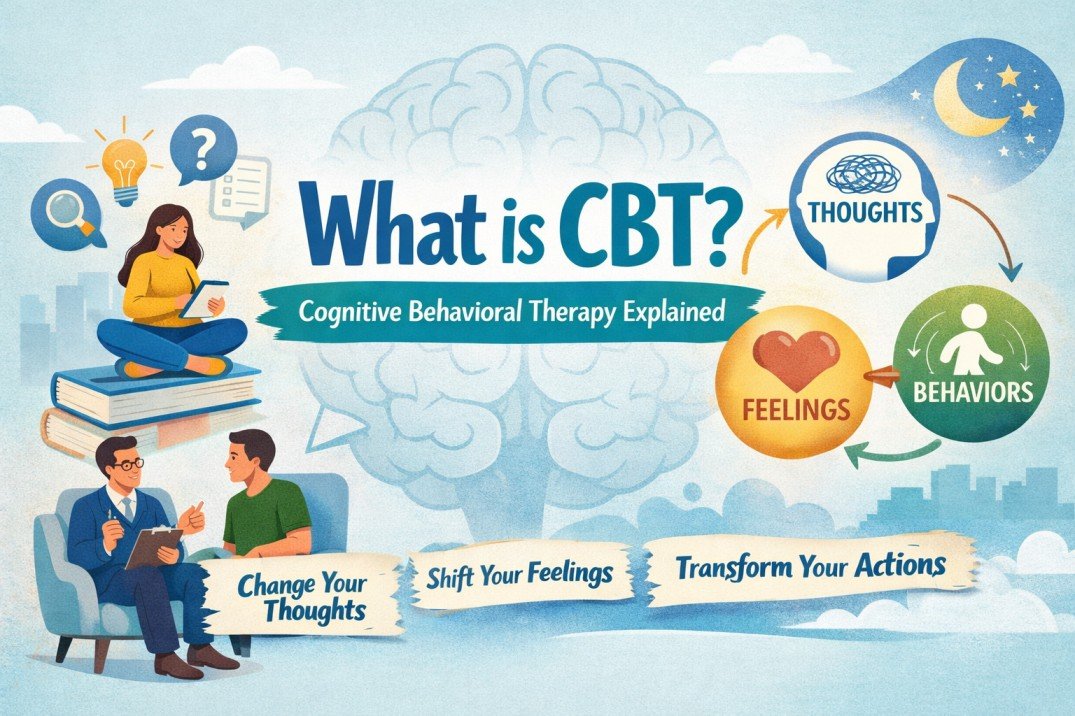
Cognitive Behavioral Therapy (CBT) is a structured, goal-oriented form of psychotherapy that focuses on identifying and changing unhelpful patterns of thinking and behavior. It is based on a powerful concept: your thoughts influence your emotions, and your emotions influence your actions. By learning to recognize and adjust these patterns, CBT helps create meaningful and lasting improvements in mental well-being.
How CBT Works
CBT is focused on the present. Instead of exploring past experiences in depth or analyzing unconscious processes, it concentrates on what is happening in your current life.
A therapist helps you identify thoughts that are inaccurate, negative, or unhelpful. These thoughts are then challenged using real evidence and replaced with more balanced and realistic ones.
CBT works through three connected components:
- Thoughts – what you tell yourself
- Feelings – your emotional response
- Behaviors – how you act
When a distorted thought appears, it can trigger negative emotions and lead to unhealthy behaviors. Those behaviors then reinforce the original thought, creating a cycle. CBT helps break this cycle by targeting the thought patterns at the root.
Sessions are structured and collaborative. You and your therapist set an agenda, work through specific techniques, and assign exercises to practice between sessions. This practice outside of sessions is essential—most of the real progress happens there.
Also Read: What Are The 4 Types Of Family Therapy?
What CBT Treats
CBT is one of the most widely researched forms of psychotherapy and is effective for a variety of mental health conditions, including:
- Depression
- Anxiety disorders
- PTSD (Post-Traumatic Stress Disorder)
- OCD (Obsessive-Compulsive Disorder)
- Phobias
- Eating disorders
- Panic disorder
- Insomnia
A specialized form called CBT-I (Cognitive Behavioral Therapy for Insomnia) is particularly effective for sleep issues. It often produces better long-term results than medication because it addresses the underlying thought patterns and habits, not just the symptoms.
Also Read: How Much Does Couples Therapy Cost?
Core Techniques of CBT
Cognitive Restructuring
This technique focuses on identifying distorted thoughts and replacing them with more accurate ones.
For example:
“I always fail” becomes
“I have failed at some things, but I’ve succeeded at others.”
The goal is accuracy—not forced positivity.
Behavioral Activation
Depression often leads to withdrawal from activities that bring meaning or enjoyment. Behavioral activation works by encouraging you to engage in those activities first—even when motivation is low.
Action comes before motivation, and mood improvement follows.
Exposure Therapy
Anxiety often grows stronger through avoidance. Exposure therapy gradually helps you face feared situations in a safe and controlled way.
Over time, your brain learns that the situation is not a threat, and anxiety naturally decreases.
Limitations to Know
CBT is highly effective, but it is not a one-size-fits-all solution.
- It requires active participation and effort
- Severe depression may need medication or higher-level care before CBT is effective
- Some individuals benefit more from deeper, relationship-focused therapies like psychodynamic therapy
CBT works best when it aligns with the individual’s needs and readiness.
Also Read: What Does A Relationship Therapist Do?
Frequently Asked Questions
Is CBT effective for depression?
Yes. CBT is one of the most researched treatments for depression and is as effective as medication for mild to moderate cases. Its benefits often last longer because it teaches practical skills.
How many CBT sessions do I need?
Many people notice improvement within 8–12 sessions. A full course typically ranges from 12 to 20 sessions, depending on the condition and level of engagement.
Can I do CBT online?
Yes. Online CBT has been shown to be just as effective as in-person therapy for many conditions.
Does insurance cover CBT in California?
Most insurance plans cover outpatient therapy under mental health parity laws. Coverage varies, so it’s best to verify with your provider.
What if CBT does not work for me?
If CBT doesn’t provide results, other approaches like DBT, schema therapy, psychodynamic therapy, or medication may be more suitable. Treatment should always be personalized.
Conclusion
CBT is one of the most effective and well-researched therapies available today. It provides a clear framework for understanding how your thoughts, emotions, and behaviors are connected and offers practical tools to change them. It is widely used for conditions such as depression, anxiety, PTSD, OCD, insomnia, and more.
However, no method works in isolation. The connection between you and your therapist plays a critical role in your progress. At Lumen Health & Psychological Services Inc., CBT is tailored to each individual, ensuring that treatment is aligned with your unique needs rather than a fixed protocol. If you’re ready to take the next step toward better mental health, the right support can make all the difference.