
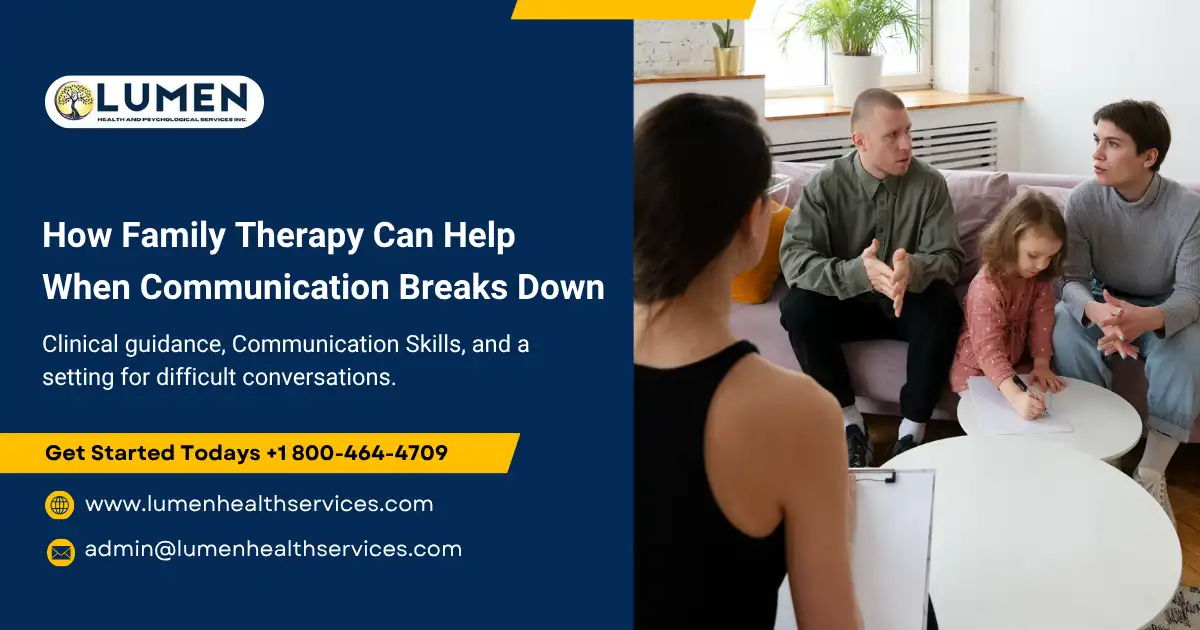
Family therapy can help when communication becomes stuck in repeated arguments, silence, blame, defensiveness, or emotional withdrawal. A family therapist offers a safe environment for family members to learn about these patterns of interaction, communicate more clearly, and learn healthier, more effective communication strategies for family dynamics.
Family therapy does not simply encourage family members to talk more. It emphasizes the way individuals react to others and identifies the dynamics in the family that sustain conflict. Family members can also benefit from therapy to learn to express feelings, understand the other person’s point of view, and communicate effectively.
What Does Communication Breakdown Look Like in a Family?
Communication problems do not always involve shouting or obvious conflict. Communication can break down in a family in several ways: by going silent, by avoiding each other, by criticizing, by being defensive, and by having misunderstandings repeat themselves over time.
Common signs include:
- The same argument happens repeatedly without resolution.
- Family members interrupt or talk over one another.
- Someone regularly shuts down during difficult conversations.
- Parents and children struggle to discuss emotions.
- Family members avoid important topics to prevent conflict.
- Small disagreements quickly become larger arguments.
- One person feels blamed for most family problems.
- Family members live together but feel emotionally disconnected.
These patterns can reinforce one another. One person may become defensive, another may push harder to be heard, while someone else withdraws. The conversation may end without resolving the original concern.
Why Do Families Get Stuck in the Same Communication Patterns?
The transmission of information can be difficult and go beyond the words that are used.
Changes in relationships within the family, such as stress, grief, disagreements with parents as parents, divorce, blended families, trauma, mental health issues and unresolved relationship issues can all impact how family members interact.
Family Therapists consider these patterns in the family system. Therapy can look at the events leading up to an argument, during an argument, and after an argument, rather than just focusing on who is to blame for starting the conflict.
For instance, a teen might decide to cease speaking if he or she feels that talking was judgmental. A parent might ask further questions as a result of being concerned. The teen can then go even further into isolation. The family can become aware of this cycle and learn a different reaction through family therapy.
How Can Family Therapy Improve Communication?
Family therapy creates a structured environment for difficult conversations. A therapist can help family members slow down interactions, clarify what they mean, and understand how their behavior affects other people.
Identifying Unhelpful Interaction Cycles
A therapist may identify patterns such as criticism followed by defensiveness or repeated attempts to engage followed by withdrawal.
Recognizing these patterns can help family members move away from personal blame and focus on changing the interaction itself.
Building Active Listening Skills
Active listening means paying attention to what another person says before preparing a response. It can help family members understand concerns more accurately and reduce misunderstandings.
For parents and caregivers, active listening can also create more opportunities for children and adolescents to communicate their thoughts and emotions openly.
Expressing Feelings and Needs Clearly
Therapy can help family members replace accusations with clearer statements about feelings, needs, and concerns.
This does not mean avoiding disagreement. Healthy communication allows family members to disagree while maintaining respect and emotional safety.
Practicing Conflict Repair
Families may learn how to pause an escalating conversation, return to an unresolved issue, acknowledge harm, and make a specific request for change.
The goal is not to eliminate every disagreement. The goal is to help family members handle disagreements without repeatedly damaging their relationships.
What Happens During Family Therapy?
The process varies according to the family’s concerns, relationships, and treatment goals.
A therapist may begin with an assessment to understand the main concerns, family dynamics, stressors, and goals. The therapist can then develop a treatment plan that addresses communication, conflict, parenting concerns, emotional connection, or another presenting concern.
Sessions may include the entire family or selected family members. Not every person needs to attend every session in every treatment plan. The therapist may adjust the format as therapy progresses.
During family therapy, family members may:
- Describe their concerns and treatment goals.
- Identify recurring communication patterns.
- Practice listening and emotional expression.
- Discuss difficult situations with therapist guidance.
- Develop practical strategies for handling conflict.
- Practice new communication skills between sessions.
Progress depends on the family’s circumstances, participation, treatment goals, and response to therapy.
Can Family Therapy Help With Parent-Child Communication?
Yes. Family therapy can help parents and children understand each other’s perspectives and develop healthier communication patterns.
This can be particularly useful when conversations repeatedly end in arguments, avoidance, criticism, or shutdown.
Family therapy provides a structured setting where parents and children can practice listening, expressing concerns, and responding to one another more effectively.
For families who have already tried to improve communication on their own without lasting progress, working with a family therapist can provide additional structure and guidance.
Can Online Family Therapy Work in California?
Online therapy can provide an accessible option for families who cannot easily attend in-person appointments.
Telehealth may be useful for families managing busy schedules, transportation challenges, distance, or other barriers to attending appointments. Research supports the use of telehealth for a range of family and mental health concerns, although therapists may need to adapt engagement, communication, and safety practices for virtual sessions.
Lumen Health Services provides family counseling through secure telehealth across California, with in-person sessions available at its Citrus Heights office.
Also Read: How does family therapy work?
When Should a Family Consider Therapy?
A family may benefit from professional support when communication problems continue despite repeated attempts to resolve them.
Consider speaking with a family therapist when:
- Arguments happen frequently.
- Family members avoid important conversations.
- Parent-child communication has become consistently difficult.
- Emotional distance continues to grow.
- Family conflict affects daily life.
- A major life transition has changed family relationships.
- A family member’s mental health concerns affect the household.
- The same conflict continues without reaching a resolution.
You do not have to wait until a family reaches a crisis before seeking support.
What Family Therapy Can and Cannot Do
Family therapy can provide structure, clinical guidance, communication skills, and a setting for difficult conversations. It cannot guarantee that every family member will agree or that every relationship will return to the way it was before.
Progress also varies between families. Some families may notice changes relatively early, while others may need longer-term support because they face complex or longstanding concerns.
Family therapy may require a different approach when there is active abuse, coercive control, or an immediate safety concern. In these situations, safety assessment and appropriate specialized support take priority.
For California residents experiencing a mental health crisis, 988 provides immediate crisis support.
Also Read: Family Therapy Models
Take the Next Step With Lumen Health Services
Communication problems can become difficult to change when the same interaction pattern repeats for months or years. Family therapy gives families a structured opportunity to understand those patterns and practice healthier ways to communicate.
Lumen Health Services provides family therapy in California through telehealth and in-person care in Citrus Heights. Treatment can be tailored to the family’s concerns, relationships, and goals.
If your family is struggling with recurring conflict or communication problems, contact Lumen Health Services to discuss whether family therapy fits your needs.
You can also schedule a family therapy consultation with Lumen Health Services to discuss your concerns and available care options.
FAQ’s
Family therapy helps family members identify recurring communication patterns, practice active listening, express concerns more clearly, and learn ways to manage conflict without escalating it.
A therapist can help family members understand what keeps a conflict repeating and guide them through structured conversations and practical conflict-resolution strategies.
Not necessarily. A therapist may work with the entire family, selected family members, or different combinations depending on treatment goals and clinical needs.
There is no single treatment length that works for every family. Duration depends on the family’s concerns, goals, participation, and response to treatment.
Yes. Family therapy can help parents and children understand each other’s perspectives and develop more effective ways to communicate.
Research supports telehealth family therapy for a range of family and mental health outcomes. Therapists may adapt how they build engagement, conduct sessions, and address safety concerns during virtual treatment.
Consider family counseling when communication problems, recurring conflict, emotional distance, or major family changes continue to interfere with relationships or daily life.
Also Read: