Social media can affect teen mental health in both positive and negative ways. It can be used to keep teens connected with friends, be a creative outlet, help teens find supportive communities, and help access mental health information. Meanwhile, some online social media behaviors can foster anxiety, low self-esteem, sleep issues, social comparisons, cyberbullying, body image issues, and emotional distress.
The effects are different for each teen. Factors that could affect the outcome include frequency of social media usage, content seen on social media, interactions with others, and social media replacing sleep, physical activity, schoolwork or in-person interactions.
Social media poses real threats to adolescent mental health, but also offers opportunities, says the U.S. Surgeon General. There is no conclusive evidence as yet to prove that social media is safe for children and adolescents.
Social Media Is Bad for Mental Health When It Starts Affecting Daily Life
Saying that social media is bad for mental health oversimplifies the research.
The more useful question is whether social media use is affecting a teenager’s functioning.
Social media may become a concern when a teenager:
- Regularly loses sleep because of social media
- Withdraws from family or friends
- Stops participating in hobbies or activities
- Becomes highly distressed about likes or comments
- Constantly compares their appearance with others
- Experiences cyberbullying
- Avoids school or social situations
- Feels anxious after using social media
- Cannot reduce social media use despite negative consequences
- Experiences a noticeable decline in mood or confidence
These signs do not prove that social media caused a mental health condition. They indicate that the teenager may need additional support.
Our Therapist: margit-ilgen
Social Media and Mental Health Statistics
Current social media and mental health statistics show why this topic deserves attention without suggesting that every teenager experiences the same effects.
Pew Research Center’s 2025 report found:
- 19% of teens said social media hurt their mental health.
- 45% said social media hurt the amount of sleep they get.
- 15% said social media hurt their confidence.
- 74% said social media makes them feel more connected to friends.
- 63% said social media gives them a place to show their creative side.
- 45% said they spend too much time on social media.
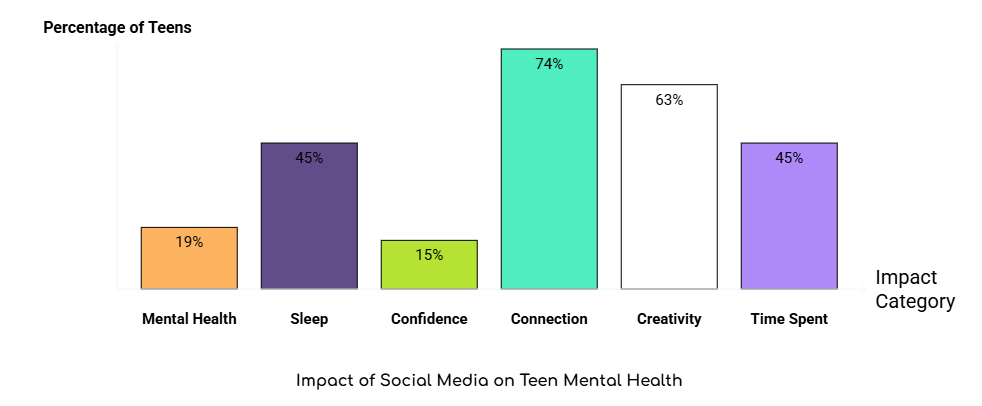
These findings demonstrate that the impact of social media on mental health is not simply positive or negative. Many teenagers report both benefits and problems.
Research reviews also emphasize that the relationship between social media use and adolescent mental health is complex. Researchers continue to investigate which types of online experiences create the greatest risks and which factors protect young people.
Sourced By: pewresearch.org
How Does Social Media Affect Teenagers With Social Anxiety?
Social media can have a particularly complicated role for teenagers with social anxiety.
Online communication may initially feel easier because a teenager has more time to think before responding. It can also be a way for teens to stay in touch with friends when socializing in person is tricky.
But social media has the potential to reinforce fear of judgment as well.
The teen with social anxiety can check messages over and over, think about what people will think of their post, not do video calls, not post anything owing to fear of criticism, or compare their social life to other teens.
When online communication is the only way to communicate with most people, there may be a decrease in opportunities to practice social skills.
When parents want to help a teen with social anxiety, they should pay attention to the teen’s functioning rather than to social media.
How to Help a Teenager With Social Anxiety and Social Media Stress
Parents can help by creating an environment where teenagers can discuss online experiences without immediately fearing punishment.
Start with simple questions such as:
“What do you enjoy about social media?”
“Is anything online making you uncomfortable?”
“Do you ever feel worse about yourself after scrolling?”
“Is social media affecting your sleep?”
For teenagers with social anxiety, parents should avoid forcing them into overwhelming social situations. Instead, gradual support can help them build confidence.
If anxiety interferes with school, friendships, family relationships, or everyday activities, professional support may be appropriate.
Also Read: how to help a teen with social anxiety
What Therapy Can Help With Teen Social Anxiety?
CBT (cognitive behavioral therapy) is a proven treatment that is often used for anxiety disorders.
CBT teaches teenagers to identify negative thinking patterns and to see the relationship between thoughts, feelings, physical symptoms, and behaviors.
Treatment for social anxiety can involve gradual exposure to feared situations. A therapist can help a teen create a plan that is gradual, instead of putting him or her in scenarios that will make him or her feel overwhelmed.
Treatment can also focus on self-esteem, avoidance, communication skills, coping strategies, and family factors that impact anxiety.
This is not a set number of sessions that will work for every teen. Treatment usually varies in length depending on the severity of the symptoms, length of time, other mental health issues, family support and the teen’s reaction to therapy.
Also Read: What is CBT?
When Should Parents Seek Professional Help?
Parents should consider professional support when changes in a teenager’s behavior persist or interfere with daily functioning.
Look for signs of ongoing sadness, anxiety, withdrawal, sleep issues, school problems, extreme body image concerns, distress from cyberbullying, and more avoidance of social situations in teens that warrant an assessment.
A mental health professional can determine if social media is the primary concern or if it is an interaction with anxiety, depression, low self-esteem, family stress, bullying or another issue.
Professional intervention can focus on the underlying concern instead of merely decreasing screen time.
Also Read: Best Psychologist for Anxiety and Depression in Citrus Heights
How Can Parents Create Healthier Social Media Habits?
Parents can help their teens adopt healthy habits without completely blocking social media.
Establish reasonable limits for phone usage in times of meals, homework, family time and bedtime.
Be aware of protecting sleep and encourage teens to turn off devices before going to bed and to not get notifications while asleep.
Discuss edited images, filters, comparison on the internet, advertising and expectations.
Encourage offline activities such as exercise, hobbies, creative activities, sports, family time, and face-to-face friendships.
Above all, make sure the lines of communication stay open. When teens feel heard, not judged, they are more inclined to talk about cyberbullying, anxiety, body image issues or uncomfortable online experiences.
Final Thoughts
The impact of social media on mental health depends on what teenagers experience online and how those experiences affect their daily lives.
Social media can provide friendship, creativity, community, and useful information. It can also contribute to anxiety, comparison, sleep disruption, cyberbullying, body image concerns, and low confidence.
Parents should focus on the teenager rather than only the screen-time number. Changes in sleep, mood, confidence, relationships, school performance, or social behavior can provide important clues that additional support may be needed.
If your teenager is struggling with social anxiety, emotional distress, or the effects of social media, Lumen Health & Psychological Services provides professional mental health support for teens and families in Citrus Heights, CA, and throughout California through telehealth therapy.
Learn more about teen therapy or contact Lumen Health & Psychological Services to discuss support options.
FAQ’s
Social media can affect teen mental health through comparison, cyberbullying, sleep disruption, appearance pressure, and online rejection. It can also support friendships, creativity, community, and access to information.
The effects of social media on teens can include anxiety, low confidence, body image concerns, sleep problems, and cyberbullying. Positive effects include social connection, creativity, and supportive communities.
Social media is not automatically bad for mental health. Its effects depend on content, interaction, frequency of use, individual vulnerability, and whether social media interferes with sleep, relationships, school, or daily activities.
Social media positive effects can include stronger friendships, creative expression, community support, communication, and access to educational or mental health information.
Social media can contribute to anxiety for some teenagers, particularly when they experience comparison, online rejection, cyberbullying, pressure to respond, or fear of judgment. Anxiety usually develops through multiple factors.
In Pew Research Center’s 2025 survey, 19% of teens said social media hurt their mental health, 45% said it hurt their sleep, and 15% said it hurt their confidence. At the same time, 74% said it helped them feel connected to friends.
Listen without judgment, encourage gradual participation in social situations, support healthy sleep and daily routines, and consider professional therapy when anxiety interferes with everyday life.
A teenager with social anxiety may benefit from supportive conversations, gradual exposure to manageable social situations, coping strategies, and evidence-based therapy such as CBT when symptoms significantly interfere with daily life.
Also Read:
How Much Does Family Therapy Cost?
10 Questions to Ask Before Starting Therapy in 2026
How Does Child Therapy Work Step by Step?
Best Psychologist for Anxiety and Depression in Citrus Heights, CA