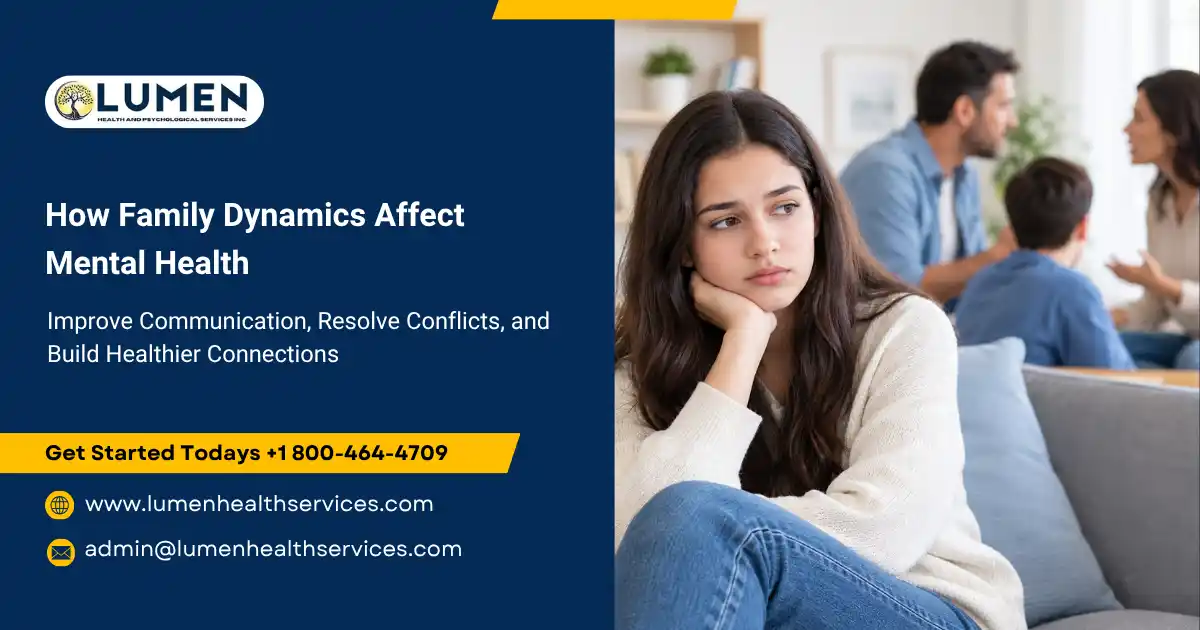
Family dynamics affect mental health by shaping how people communicate, manage emotions, build relationships, and respond to stress. Good family relationships can build emotional security and resilience, and recurrent family conflict, criticism, neglect or controlling behavior may lead to emotional distress. The comprehended family dynamics enable people to be able to notice unhealthy patterns and build healthy relationships.
Family conflict and poor communication are considered risk factors for adverse childhood experiences by the Centers for Disease Control and Prevention (CDC). It also identifies safe, stable and nurturing relationships as protective factors. However, family experiences affect each person differently, and no single family pattern determines someone’s mental health outcome.
What Are Family Dynamics? Meaning and Definition
Family dynamics involve the relationships between family members, their communication, their emotions, how they resolve disagreements, their decision making and their responsibilities.
These patterns are established over the course of family history, parenting, expectations, experiences, financial situations, and evolving relationships. Families can evolve from one generation to the next, or when parents grow older, or when children grow up in a single-parent home, or when the family structure changes, for example.
Knowing about family relations involves more than just understanding the behavior of each member of a family; it involves understanding how family members affect each other.
For example, a parent who listens calmly when a teenager expresses frustration may encourage trust and honest communication. A parent, on the other hand, who criticizes them for all disagreements may make the teen wary of bringing up issues.
Both examples are not enough to diagnose someone’s mental health. Over time, repeated interactions may shape family member’s emotional, problem-solving, and relational schemas.
How Do Family Dynamics Affect Mental Health?
Family dynamics can influence emotional well-being, self-esteem, stress management, and relationship patterns. The effects depend on the frequency and severity of family conflict, the availability of support, and each person’s circumstances.
1. Anxiety and Ongoing Stress
Frequent arguments, unpredictable reactions, or constant tension can leave family members feeling worried or on edge. Children may become especially concerned when they regularly witness intense conflict between caregivers.
Adults can also experience stress when family relationships involve persistent criticism, pressure, or unresolved disagreements.
2. Self-Esteem and Confidence
Encouragement helps people recognize their strengths and learn from mistakes. Repeated humiliation, comparison, or dismissive comments can undermine confidence and create persistent self-doubt.
For example, comparing siblings’ academic performance may make one child feel inadequate, even when they work hard or achieve personal goals.
3. Depression and Emotional Isolation
Family members who feel ignored, rejected, or unsupported may experience loneliness and emotional distress. Ongoing conflict and limited emotional connection can contribute to depressive symptoms in some people.
Depression has multiple possible causes, so family difficulties should not be treated as the only explanation for someone’s symptoms.
4. Relationships and Emotional Regulation
People often learn how to express feelings, handle disagreement, and establish boundaries through early relationships. Repeated exposure to aggressive communication or emotional withdrawal may make these skills harder to develop.
Some adults may avoid conflict because disagreement feels threatening. Others may struggle to express their needs or trust people in close relationships. These patterns can change with awareness, practice, and appropriate support.
The CDC’s guidance on adverse childhood experiences explains that certain stressful or traumatic experiences can have lasting effects on health and development. These associations do not mean that every person who experiences family conflict will develop a mental health condition.
What Are the Different Types of Family Dynamics?
Family dynamics do not fall into one universal classification. The following categories describe common relationship patterns rather than formal psychiatric diagnoses.
1. Healthy and Supportive Family Dynamics
A healthy family dynamic encourages respect, emotional safety, honest communication, and appropriate independence. Family members can disagree without threats or humiliation.
Example: A parent listens to a child’s concerns, explains household rules, and allows age-appropriate choices.
2. Authoritarian or Highly Controlling Dynamics
This pattern involves strict expectations, limited autonomy, and a strong emphasis on obedience. Rules can provide structure, but excessive control may discourage honest communication and independence.
Example: A teenager feels unable to discuss school difficulties because their parents respond with punishment instead of listening.
3. Conflict-Driven Family Dynamics
Frequent arguments, blame, criticism, or unresolved resentment characterize this pattern. Family members may repeat the same disagreements without reaching workable solutions.
Example: Parents argue about discipline, and children feel pressured to take sides.
4. Emotionally Distant Family Dynamics
Family members may share a home but rarely discuss their feelings or offer emotional support. Practical needs might be met while emotional connection remains limited.
Example: An adult experiencing distress avoids asking family members for help because previous attempts received dismissive responses.
5. Enmeshed Family Dynamics
Enmeshment occurs when boundaries become blurred and family members struggle to maintain appropriate independence. One person’s decisions or emotions may become everyone’s responsibility.
Example: A parent expects an adult child to share every personal decision and interprets reasonable privacy as rejection.
6. Disengaged or Disconnected Family Dynamics
Family members may have limited involvement in one another’s lives, little communication, or minimal shared support. This pattern differs from healthy independence because emotional needs may remain consistently unmet.
7. Blended or Changing Family Dynamics
Blended families, single-parent households, multigenerational households, and families navigating separation may need to adjust roles, expectations, and routines.
These family structures are not inherently unhealthy. Challenges often arise when members struggle with unclear expectations, competing responsibilities, loyalty conflicts, or major life changes.
What Are Examples of Toxic Family Dynamics?
Toxic family dynamics describe persistent patterns of interaction that cause emotional harm, undermine autonomy, or create an unsafe environment. The term is informal rather than a clinical diagnosis.
Examples include:
Constant criticism: A family member repeatedly attacks someone’s character instead of discussing a specific behavior.
Manipulation and guilt: Someone uses guilt, threats, or emotional pressure to control another person’s decisions.
Favoritism: Caregivers consistently compare siblings or treat one child as more deserving of affection.
Parentification: A child takes on inappropriate adult responsibilities, such as managing a parent’s emotional needs or caring for siblings without adequate support.
Boundary violations: Family members repeatedly ignore reasonable requests for privacy or personal space.
Emotional invalidation: Someone dismisses another person’s feelings as unimportant, exaggerated, or unacceptable.
Triangulation: A family member pulls another person into a disagreement rather than addressing the issue directly.
A single disagreement does not establish a toxic pattern. Look at whether harmful behavior happens repeatedly, whether family members take responsibility, and whether people can raise concerns without fear.
Abuse, threats, and coercive control require particular attention to safety. No one needs to tolerate harmful behavior to preserve a family relationship.
What Does a Healthy Family Dynamic Look Like?
A healthy family dynamic does not require perfect agreement or constant happiness. It allows family members to disagree, repair misunderstandings, and respect one another’s needs.
Common signs include:
Open communication: Family members can express concerns without routinely facing ridicule or punishment.
Respectful boundaries: People respect privacy, personal decisions, and age-appropriate independence.
Emotional support: Family members listen and offer practical help during difficult periods.
Fair expectations: Responsibilities reflect each person’s age, capacity, and circumstances.
Accountability: People acknowledge mistakes, apologize, and work toward repairing harm.
Flexible problem-solving: Family members adjust routines and expectations when circumstances change.
Families can strengthen these habits gradually. Small improvements in listening, consistency, and conflict resolution can make everyday interactions more constructive.
How Can You Improve Unhealthy Family Dynamics?
Changing established family patterns takes time. Start with manageable steps rather than expecting everyone to change immediately.
1. Identify Repeated Patterns
Notice when arguments occur, what triggers them, and how family members respond. Focus on observable behaviors rather than assigning labels or assuming motives.
2. Communicate Clearly and Calmly
Use specific statements about your experiences and needs. For example, say, “I feel overwhelmed when we discuss several problems at once. Can we address one issue first?”
3. Establish Healthy Boundaries
Explain what you can reasonably accept and what you will do if a conversation becomes insulting or threatening. Boundaries guide your own choices; they do not guarantee that another person will change.
4. Practice Emotional Regulation
Take a break when conversations become overwhelming, use grounding techniques, and return to the discussion when it feels safe and productive. Avoid using a break to punish or intimidate another person.
5. Seek Professional Support
A licensed therapist can help family members understand interaction patterns, improve communication, and develop practical ways to resolve disagreements.
Family therapy may involve several relatives working together. Individual therapy may be more appropriate when someone needs private support, wants to explore personal experiences, or cannot safely participate in joint sessions.
How Can Family Therapy Help Improve Family Dynamics?
Whereas family therapy deals with patterns of relationships and not the idea that one person is doing all the things wrong. A therapist assists family members in discovering patterns of conflict, in gaining new insights into family members’ viewpoints, and in learning to communicate more effectively.
Family therapy is available at Lumen Health and Psychological Services in California, and can be done in person at their Citrus Heights office, or via secure telehealth throughout California. Family therapy skills include Structural Family Therapy, Bowenian Family Therapy and Emotionally Focused Family Therapy, which are chosen based on the family’s needs.
Treatment may involve:
Understanding family roles: Identifying patterns that contribute to repeated conflict or unclear responsibilities.
Improving communication: Practicing active listening, respectful disagreement, and direct expression of needs.
Strengthening boundaries: Helping family members balance connection with appropriate independence.
Building problem-solving skills: Developing practical agreements about parenting, routines, responsibilities, and conflict resolution.
Each family makes their own progress. A few may find that things go better with communication before greater disagreements are resolved. In other instances a longer-term intervention, individual treatment or extra support will be needed.
Therapy will not ensure reconciliation, resolve all differences or get a reluctant family member to change. The clinician should first evaluate safety when abuse and/or coercive control is suspected, before considering joint sessions.
If recurring conflict is affecting your family’s emotional health, contact Lumen Health about family therapy in California to discuss available support and whether this approach fits your needs.
Build Healthier Family Relationships With Support
Family dynamics can influence mental health, but harmful patterns do not have to define every future relationship. Greater awareness, clear boundaries, respectful communication, and appropriate professional support can help people respond to family challenges more effectively.
Lumen Health and Psychological Services provides family therapy in Citrus Heights and secure telehealth across California. If family conflict, communication problems, or emotional distance are affecting your household, contact Lumen Health to discuss your options and take a practical first step toward healthier family relationships.
FAQ’s
Family dynamics are the patterns through which family members communicate, manage emotions, make decisions, and respond to one another. These patterns can support emotional health or contribute to distress.
Family dynamics can influence self-esteem, emotional regulation, stress management, and relationship skills. Supportive relationships may strengthen resilience, while persistent conflict or harmful treatment may increase emotional distress.
There is no universally accepted list of five types. Common patterns include healthy and supportive, controlling, conflict-driven, emotionally distant, and enmeshed dynamics. Families may show several patterns at once.
Repeated manipulation, humiliation, boundary violations, controlling behavior, emotional invalidation, and fear of expressing concerns can indicate unhealthy family patterns. Consider their frequency, severity, and impact rather than relying on one incident.
Unhealthy family relationships can contribute to stress and emotional distress, and they may increase the risk of mental health difficulties. Anxiety and depression have multiple causes, so a qualified professional can help assess an individual’s circumstances and symptoms.
Look for a licensed mental health professional with experience in family relationships, conflict resolution, and communication. Ask about treatment approaches, participation requirements, fees, insurance, and telehealth options. Lumen Health offers family therapy in person in Citrus Heights and through secure telehealth across California.
Yes. Individual therapy can help someone understand family patterns, practice boundaries, and develop coping strategies even when other relatives do not participate. A therapist can help determine whether individual or joint treatment is appropriate.
There is no fixed timeline. Progress depends on the family’s goals, the nature of the conflict, participation, and the consistency of changes between sessions. A therapist can review progress and adjust the treatment plan as needed.
Also Read:
How Family Therapy Can Help When Communication Breaks Down
Best In-Person Mental Health Care in Citrus Heights, CA
Individual Therapy for Adults in Northern California