
Cognitive Processing Therapy (CPT) is a trauma-focused, structured psychotherapy that was developed to treat post-traumatic stress disorder (PTSD). It is a form of CBT which focuses on recognizing and modifying unhelpful thoughts associated with a traumatic event. CPT focuses on how trauma can change the way a person understands themselves, other people, and the world.
What Is Cognitive Processing Therapy?
Cognitive Processing Therapy (CPT) is a evidence-based treatment that is mainly used for PTSD. It assists people to reflect on thoughts and beliefs that could be continuing to cause distress following a traumatic event.
After trauma, someone may develop thoughts such as “It was my fault,” “I cannot trust anyone,” or “Nowhere is safe.” These are the sorts of trauma-related beliefs that CPT calls “stuck points.” The goal is not to ignore what happened or simply replace difficult thoughts with positive ones. Instead, CPT helps a person examine whether their beliefs are supported by the available facts and develop a more balanced understanding of what happened.
How Does Cognitive Processing Therapy Work?
The concept of CPT is based on the premise that trauma can interfere with pre-existing views of safety, trust, control, self-worth, and relationships.
Treatment begins with education about PTSD and the connection between thoughts, emotions, and behaviors. The therapist then helps the person identify trauma-related thoughts that may be maintaining distress.
One of the key components of CPT is cognitive restructuring. The person learns to look at an impasse, reflect on evidence for and against the impasse, and refine his/her interpretation of the impasse.
For example, someone who survived a traumatic event may believe, “I should have prevented it.” In CPT, the therapist can assist the person to explore what they actually did know, control, and were able to do at the time. This can help to lessen excessive guilt or self-blame while not diminishing the seriousness of the trauma.
What Are “Stuck Points” in CPT?
Stuck points are thoughts or beliefs about trauma that block healing. They can be thoughts of self-blame, of always looking for danger, of not trusting anyone or of feeling permanently damaged.
CPT commonly addresses stuck points involving five areas:
- Safety: How safe do I feel around other people or in the world?
- Trust: Can I trust myself or other people?
- Power and control: Do I have control over my life and decisions?
- Esteem: How do I view myself and other people?
- Intimacy: Can I form or maintain close relationships?
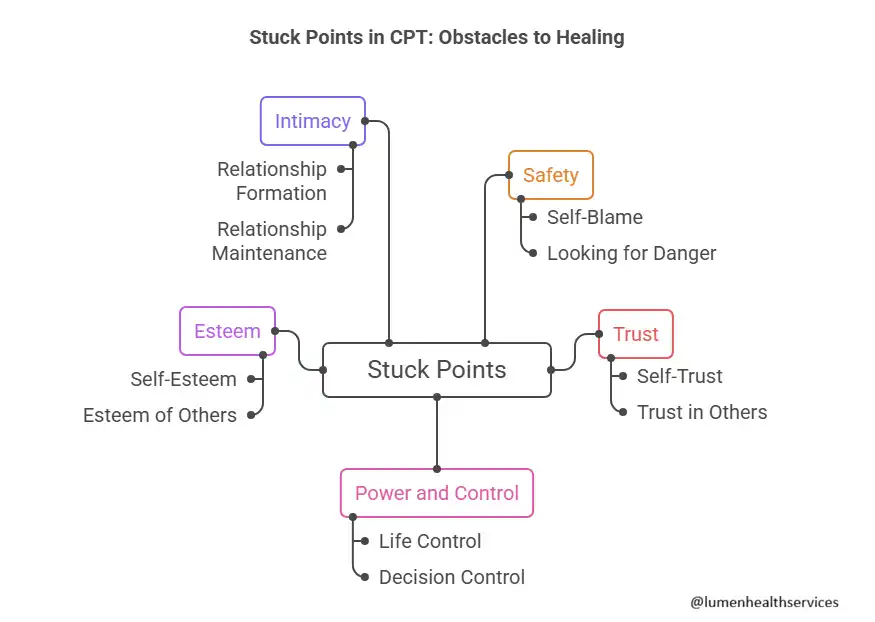
These themes can help organize treatment around the areas most affected by the traumatic experience.
What Happens During Cognitive Processing Therapy?
CPT usually follows a structured process, although the exact treatment plan can vary.
Early sessions typically include education about PTSD and an introduction to the relationship between thoughts and emotions. The therapist and client begin identifying stuck points and learning ways to evaluate them.
As treatment continues, the person practices cognitive restructuring using structured questions and worksheets. These exercises help examine evidence, identify patterns in thinking, and develop more balanced interpretations.
Some versions of CPT include a written account of the traumatic event. However, a detailed written trauma account is not required in every version of CPT. Current CPT guidance distinguishes standard cognitive-focused CPT from CPT with a written account, giving treatment some flexibility.
Does CPT Require Talking About the Trauma?
CPT involves discussing the effects and meaning of trauma, but the amount of detail can vary.
The original CPT protocol included a written trauma account. Research later found that this component is not necessary for CPT to be effective. The current CPT protocol can therefore be delivered without a detailed written trauma account, while CPT with a written account remains another option.
This distinction matters because people often assume that trauma therapy always requires repeatedly describing every detail of what happened. CPT does not work in exactly the same way for every person.
How Long Does Cognitive Processing Therapy Take?
CPT was originally developed as a 12-session treatment, and 12 weekly sessions remain a common structure. However, treatment does not always follow an identical schedule for every person.
The VA notes that the number of sessions can vary depending on individual progress and treatment needs. CPT can also be provided individually or in a group format.
People should not expect one fixed timeline for recovery. Progress can depend on symptoms, treatment engagement, personal circumstances, and other factors.
Is Cognitive Processing Therapy Effective for PTSD?
CPT has substantial research support for treating PTSD. The VA National Center for PTSD describes CPT as one of the most researched PTSD treatments, with randomized controlled trials supporting reductions in PTSD symptoms.
The American Psychological Association’s clinical practice guideline recommends CPT for adults with PTSD. The guideline bases its recommendations on a systematic review of research evidence as well as considerations such as benefits, harms, patient preferences, and applicability.
Evidence does not mean that CPT produces the same outcome for everyone. A qualified clinician should consider the person’s symptoms, circumstances, goals, and treatment preferences when determining whether CPT is appropriate.
Is CPT the Same as CBT?
CPT is a specific form of cognitive behavioral therapy, but the terms are not interchangeable.
CBT is a broad family of therapies that addresses connections among thoughts, emotions, and behaviors across many mental health concerns. CPT applies cognitive behavioral principles specifically to trauma-related beliefs and PTSD.
CPT places particular emphasis on identifying stuck points and examining beliefs connected to areas such as safety, trust, power and control, esteem, and intimacy.
Also Read: What is CBT
What Can Someone Expect From CPT?
CPT is structured and requires active participation. Sessions may include discussion, written exercises, worksheets, and practice between appointments.
Some people experience temporary emotional discomfort when discussing trauma-related thoughts or memories. The VA identifies mild to moderate discomfort as a possible part of treatment and notes that this can occur while people work through difficult material.
CPT is not about forcing someone to think positively. It focuses on developing interpretations that are more accurate, flexible, and supported by evidence.
Understanding Your Options for Trauma Treatment
Cognitive Processing Therapy is a structured, evidence-based treatment that helps people examine how trauma has affected their thoughts and beliefs. Rather than asking someone to simply “move on,” CPT provides specific strategies for identifying stuck points, evaluating evidence, and developing more balanced interpretations.
If you are experiencing PTSD symptoms or ongoing distress after a traumatic event, speaking with a qualified mental health professional can help you understand your treatment options. Lumen Health & Psychological Services provides mental health therapy and can help you discuss your concerns and determine what type of professional support may be appropriate for your situation.
Seeking professional guidance does not require you to decide on a specific therapy beforehand. A clinician can help you understand the available options based on your symptoms, goals, and circumstances.
Learn more about mental health therapy through Lumen Health & Psychological Services and take the next step toward getting appropriate support.
FAQ’s
CPT is primarily used to treat post-traumatic stress disorder. It focuses on trauma-related beliefs and thoughts that can contribute to ongoing PTSD symptoms.
CPT is commonly delivered over about 12 weekly sessions, although the actual number can vary according to individual progress and treatment needs.
Yes. CPT has extensive research support for reducing PTSD symptoms, and the American Psychological Association recommends it as a treatment for adult PTSD.
Not necessarily. CPT can be delivered without a detailed written trauma account. A version that includes a written account is also available.
Stuck points are trauma-related beliefs or interpretations that can interfere with recovery. CPT helps people examine these beliefs and develop more balanced interpretations.
CPT is a specific cognitive behavioral treatment designed for PTSD. It shares principles with CBT but uses a structured approach that focuses on trauma-related beliefs and stuck points.
Yes. CPT can be delivered individually or in a group, depending on the treatment setting and clinical circumstances.
Also Read:
10 Benefits of Mental Health Therapy
Understanding the Aim of Individual Therapy
10 Questions to Ask Before Starting Therapy in 2026
Best In-Person Mental Health Care in Citrus Heights, CA