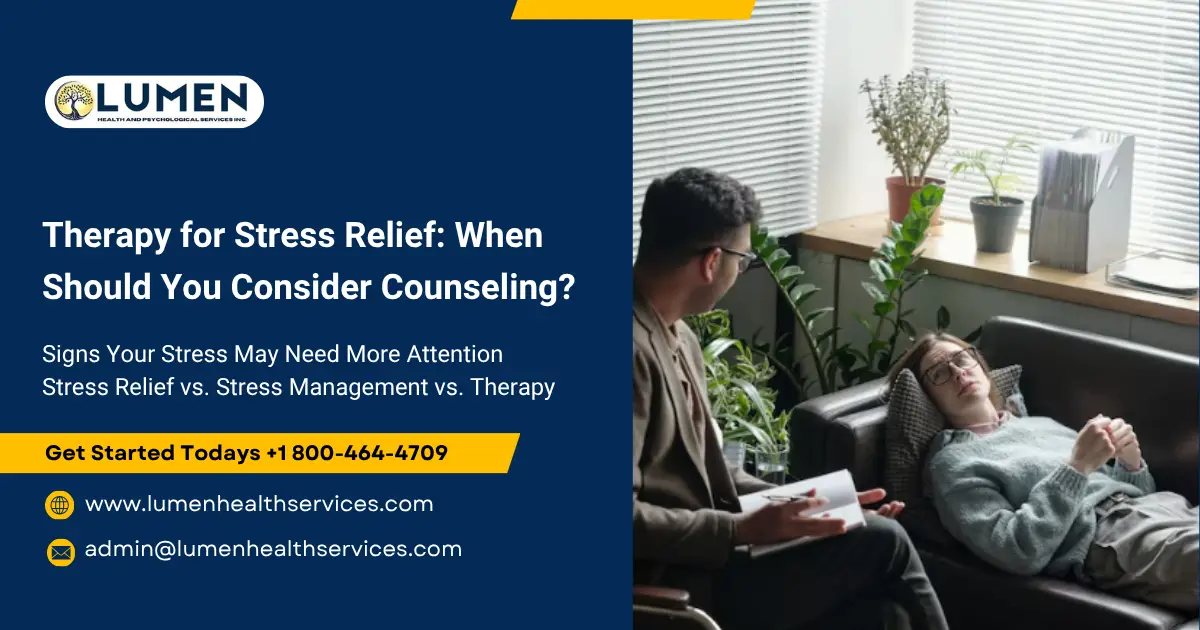
Stress relief therapy can be useful if stress becomes chronic, out of control, or affects your sleep, relationships, work, physical health, or ability to function normally. Stress relief counseling is the process of being supported to understand stressors, changing unhelpful patterns, developing coping skills, and tackling related concerns including anxiety or burnout.
Deciding when to seek counseling is not based on the number of stressful days, but rather on the impact of stress on your life and whether you are using strategies that are helping or hindering.
What Is Stress, and When Does It Become a Problem?
Stress is a normal physical and emotional reaction to difficult or challenging situations. Stress can be caused by work, relationship issues, money, health, big changes in life, or caring for others.
Stress can at times be beneficial for responding to immediate requirements. The worry grows as stress persists despite adequate recovery or when it interferes with people’s lives.
The CDC notes that long-term stress can contribute to worsening health problems and may involve changes in mood, sleep, concentration, appetite, energy, and physical symptoms.
Signs Your Stress May Need More Attention
Consider talking with a mental health professional if you notice:
- Persistent worry or feeling overwhelmed that does not ease
- Ongoing difficulty sleeping or feeling rested
- Trouble concentrating or making everyday decisions
- Irritability that affects relationships
- Frequent physical tension, headaches, or stomach problems
- Reduced ability to manage work, school, or household responsibilities
- Increased reliance on alcohol or other substances to cope
- Stress that continues despite meaningful attempts to manage it
These signs do not automatically mean you have a mental health disorder. They can indicate that additional support may be useful.
Can Therapy Help With Stress Relief?
Yes. Therapy can assist individuals to learn what is causing them stress and how to better react.
Stress reduction therapy can be beneficial for individuals who are able to recognize situations that trigger stress, to explore patterns in thinking and behavior, to build problem solving abilities, to practice emotional regulation, to define healthier boundaries and to create coping strategies that are appropriate for their situation.
The aim is not to remove all sources of stress. There are stressors that cannot be eliminated. Instead, therapy can be used to help you react to challenging situations in a manner that facilitates your functioning and life.
There are a number of psychological methods that are supported by research for stress related issues. There are structured therapies, including cognitive behavioral, mindfulness, and others, that have been researched on stress and mental health issues.
Also Read: Top 11 Types of Psychotherapy: Which Is Right for You?
When Should You Consider Stress Relief Counseling?
There is no universal threshold that determines when someone needs therapy for stress. A useful question is whether stress has become difficult to manage on your own and is affecting important parts of your life.
Stress relief counseling may be appropriate when stress begins affecting sleep, relationships, work, emotional regulation, or your ability to manage everyday responsibilities.
Consider Counseling When Stress Affects Your Sleep
Repeated difficulty falling asleep, staying asleep, or feeling rested can make coping with stress harder. Sleep problems can also affect concentration, mood, and energy.
If sleep disruption continues, discussing it with a healthcare or mental health professional can help identify possible contributing factors.
Consider Therapy When Stress Affects Your Relationships
Stress can change how people communicate and react. You may notice more arguments, withdrawal, impatience, or difficulty being emotionally present.
Therapy can provide a space to understand these reactions and practice healthier communication and boundary-setting skills.
Consider Support When Work Stress Follows You Home
Work-related stress can become particularly difficult when you remain mentally connected to work after the workday ends.
A therapist can help you examine workload-related thoughts, perfectionism, boundaries, avoidance, communication patterns, and coping strategies. Lumen provides individual therapy for adults experiencing stress and burnout, including through secure telehealth across California.
Seek Professional Help When Self-Help Is Not Enough
Breathing exercises, exercise, sleep routines, mindfulness, social support, and other healthy coping strategies can be useful. But they may not address every source of persistent stress.
If you have consistently tried reasonable strategies and continue to feel overwhelmed or unable to function as usual, professional support may be worth considering.
What Is Stress Management Therapy?
Stress management therapy focuses on helping people understand their stress responses and develop practical ways to manage ongoing pressures.
Stress management therapy can focus on unhelpful thinking patterns, feelings, communication, boundaries, time management, problem solving, relaxation techniques and other factors that cause stress depending on your needs.
The treatment approach will vary based on the nature of your stress, your objectives and if other stress-related issues, like anxiety, depression, burnout, trauma, or relationship problems, are present.
What Types of Therapy Can Help With Stress?
There is no single therapy that is right for everyone. A therapist considers your concerns, goals, history, current stressors, and preferences when developing a treatment plan.
Cognitive Behavioral Therapy for Stress
Cognitive behavioral therapy, or CBT, focuses on the connection between thoughts, emotions, and behaviors.
For stress-related concerns, CBT may help you identify patterns such as catastrophic thinking, excessive self-criticism, avoidance, or unrealistic expectations. Therapy can then focus on developing more balanced thinking and practical behavioral strategies.
Mindfulness-Based Stress Management
Mindfulness involves intentionally paying attention to present experiences with greater awareness and less automatic judgment.
Mindfulness based stress management may include practices involving breathing, physical sensations, thoughts, or present-moment awareness. Mindfulness-based stress reduction, or MBSR, has also been studied as a structured approach to managing stress.
Research has found potential benefits for stress and related mental health outcomes, although results vary and mindfulness should not be presented as a universal solution.
Other Evidence-Based Approaches
Depending on the person’s needs, therapists may use approaches such as acceptance and commitment therapy, supportive therapy, problem-solving strategies, or other evidence-based methods.
The important issue is not choosing a therapy based on a label alone. A qualified professional can help determine which approach fits the person’s goals and circumstances.
What Happens During Therapy for Stress?
The first session usually involves understanding what has been happening and what you would like to change.
A therapist may ask about:
- Current sources of stress
- How stress affects your thoughts, emotions, body, and behavior
- Sleep and daily functioning
- Relationships and work
- Previous coping strategies
- Your goals for therapy
- Other mental or physical health concerns
From there, therapy may involve education, skill development, identifying patterns, practicing new responses, and reviewing progress.
You do not need to know exactly what type of therapy you need before your first appointment.
How Long Does Stress Therapy Take?
There is no standard number of sessions for stress.
Some people seek short-term support for a specific situation. Others benefit from longer-term therapy when stress is connected to longstanding patterns, trauma, anxiety, depression, relationship difficulties, or major life changes.
Progress also varies. A responsible therapist should discuss goals and review whether treatment continues to meet your needs rather than promising a particular result or timeline.
Stress Relief vs. Stress Management vs. Therapy
These terms describe related but different ideas.
Stress relief generally refers to activities that help reduce immediate tension, such as taking a break, exercising, breathing slowly, or practicing mindfulness.
Stress management involves developing ongoing skills for recognizing stressors and responding to them more effectively.
Therapy provides professional support to understand and address patterns contributing to distress. It can include stress-management skills, but it may also explore thoughts, emotions, relationships, behaviors, and other factors affecting daily functioning.
You may benefit from stress-management strategies without needing therapy. Therapy becomes one option when stress is persistent, disruptive, or difficult to manage independently.
Can Mindfulness Help With Stress?
For some, mindfulness is an effective component of stress management. This could involve noticing the way you breathe, feeling sensations in your body, noticing your thoughts, or your environment without getting immediately caught up in them.
MBSM can be integrated into therapy if those techniques are appropriate to a person’s treatment needs and treatment goals.
Systematic reviews provide a body of evidence that suggests mindfulness-based interventions may be beneficial for stress and mental health outcomes, but there is some variation in evidence quality and outcomes are not the same for all.
Therapy is not all that is required for mindfulness to be effective. Mindfulness skills can be integrated into wider therapy as appropriate for the person.
When Is Stress an Emergency?
Most stress does not require emergency care. However, seek immediate help if you or someone else is in immediate danger, experiencing a mental health crisis, or having thoughts of suicide or self-harm.
Call or text 988 in the United States to reach the Suicide & Crisis Lifeline.
If there are medical symptoms, call an emergency medical service or seek emergency medical treatment immediately.
Finding Support for Stress Relief
You do not have to wait until stress becomes overwhelming before asking for help. If stress is interfering with your sleep, relationships, work, or ability to manage everyday responsibilities, a conversation with a qualified mental health professional can help you understand your options.
Lumen Health & Psychological Services offers personalized adult therapy sessions for issues such as stress and burnout. Lumen provides safe and secure telehealth services throughout California and in-person individual therapy at its Citrus Heights office.
When you are feeling ready to talk about what you are going through you can explore Lumen’s individual therapy options and decide if professional help is right for you.
Let’s get to the next level! Contact Lumen Health & Psychological Services to discuss individual therapy for stress and related concerns.
FAQ’s
Yes. Therapy for stress relief can help people identify stressors, understand patterns that maintain distress, develop coping skills, and address related concerns. The appropriate approach depends on the individual’s situation and goals.
Consider talking with a therapist when stress persists, interferes with sleep or daily functioning, affects relationships or work, or remains difficult to manage despite healthy coping efforts. Stress relief counseling can provide additional support when self-help strategies are no longer enough.
There is no single therapy that is right for everyone. CBT, stress management therapy, mindfulness-based approaches, and other evidence-based therapies may help depending on the person’s concerns and treatment goals.
Yes. Therapy can help identify ongoing stressors and patterns that make chronic stress harder to manage. It can also address related concerns such as anxiety, burnout, relationship difficulties, or sleep problems.
Counseling and therapy can overlap considerably. The terminology varies by professional, setting, and state licensing requirements. The most important consideration is whether the provider is appropriately licensed and qualified for the support you need.
Mindfulness-based interventions can reduce perceived stress for some people. Mindfulness based stress management may be included as part of a broader treatment plan, but results vary and mindfulness is not a substitute for individualized professional care when significant problems persist.
Also Read:
Individual Therapy for Adults in Northern California
Best In-Person Mental Health Care in Citrus Heights, CA
Academic Stress and Teen Anxiety
10 Benefits of Mental Health Therapy