Mental health therapy can help people manage difficult emotions, reduce symptoms of anxiety and depression, develop healthier coping skills, improve relationships, and handle stressful life changes. Therapy can also support people who do not have a diagnosed mental health disorder but want greater self-awareness, emotional balance, or support with a difficult situation.
Psychotherapy works in different ways depending on the person’s needs, goals, symptoms, and treatment approach. Evidence-based therapies can help people understand patterns in their thoughts and behaviors, practice new coping strategies, and improve daily functioning and quality of life.
What Is Mental Health Therapy?
Mental health therapy, also called psychotherapy or talk therapy, involves working with a trained mental health professional to address emotional, psychological, behavioral, or relationship concerns.
Therapy can involve structured techniques, guided conversations, skills practice, emotional processing, behavioral changes, or a combination of approaches. A therapist may help you identify patterns that contribute to distress and develop healthier ways to respond.
Therapy can support people dealing with anxiety, depression, trauma, grief, relationship difficulties, chronic stress, low self-esteem, life transitions, and other concerns. It can also support personal growth and emotional health.
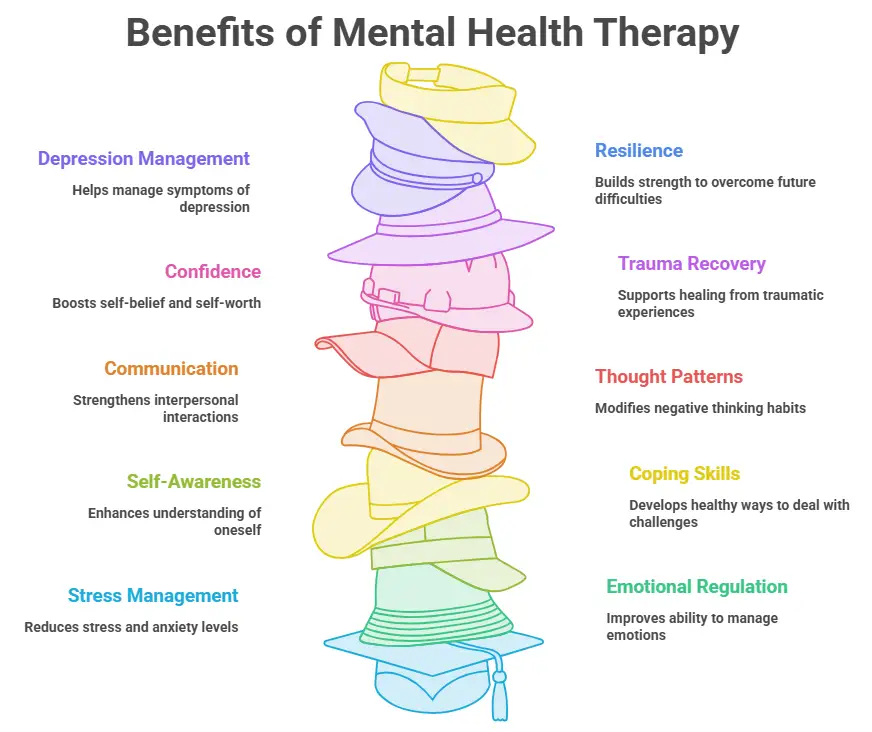
10 Powerful Benefits of Mental Health Therapy
1. Helps Manage Stress and Anxiety
One of the most common benefits of therapy is learning how to manage stress and anxiety more effectively.
Therapy can help you recognize triggers, understand anxious thought patterns, and develop practical responses to stressful situations. Depending on your needs, a therapist may use approaches such as cognitive behavioral therapy to help you identify unhelpful thinking patterns and practice healthier responses.
Research supports psychotherapy for anxiety and depression, although outcomes vary between people and treatment approaches.
2. Improves Emotional Regulation
Strong emotions can affect relationships, work, sleep, decision-making, and everyday functioning.
Therapy can help you identify emotions earlier and understand what triggers them. Instead of reacting automatically, you can practice ways to pause, evaluate what is happening, and choose a more helpful response.
This does not mean eliminating difficult emotions. Healthy emotional regulation means developing the ability to experience emotions while responding to them in constructive ways.
3. Builds Greater Self-Awareness
Therapy can help you understand how your thoughts, emotions, behaviors, experiences, and relationships connect.
You may begin to recognize recurring patterns, such as avoiding difficult conversations, expecting the worst, criticizing yourself, or becoming overwhelmed by certain situations.
Greater self-awareness can help you make more intentional choices. It can also help your therapist understand which treatment strategies may fit your goals and concerns.
4. Develops Healthier Coping Skills
Everyone experiences stress, disappointment, conflict, and uncertainty. The problem can arise when existing coping strategies no longer work.
Therapy can help you develop healthier ways to handle difficult situations. Depending on your needs, this may include problem-solving, communication skills, relaxation strategies, behavioral changes, emotional awareness, or cognitive techniques.
The goal is not to remove every challenge from your life. The goal is to help you respond to challenges with more effective skills.
5. Strengthens Communication and Relationships
Mental health affects relationships, and relationship difficulties can also affect mental health.
Therapy can help you recognize communication patterns, express needs more clearly, establish appropriate boundaries, and understand how your behavior affects others.
Individual therapy can address personal patterns that affect relationships. Couples and family therapy can focus directly on communication, conflict, trust, emotional connection, and recurring relationship difficulties.
Also Read: Signs You May Benefit from Individual Therapy
6. Changes Unhelpful Thought Patterns
Our thoughts can influence emotions and behavior. When thinking becomes consistently negative, inaccurate, rigid, or self-critical, it can contribute to emotional distress.
Cognitive behavioral therapy, commonly called CBT, addresses the relationship between thoughts, feelings, and behaviors. A therapist may help you examine automatic thoughts, evaluate whether they accurately reflect the situation, and practice more balanced ways of thinking.
CBT has substantial research support for conditions including depression and several anxiety disorders. Source: PubMed
7. Builds Confidence and Self-Esteem
Low self-esteem can affect relationships, work, decision-making, and willingness to pursue meaningful goals.
Therapy can help you examine harsh self-judgments, recognize strengths, develop realistic expectations, and build skills that support greater confidence.
Progress often comes from repeated practice rather than simply being told to “think positively.” Therapy can provide a structured environment for understanding the experiences and beliefs that contribute to low self-worth.
8. Supports Trauma Recovery
The importance of therapy is that mental health issues can impact a person in numerous ways, such as in relationships, work, school, sleep, decision making, and daily functioning.
Psychotherapy provides a framework for people to work on these concerns instead of solely avoiding and coping with them.
Psychological interventions are effective treatments for many mental health disorders, especially depression and anxiety, according to the World Health Organization (WHO). Source: WHO
Prevention can be helpful in cases where there is a problem, and therapy can be helpful as well before the problem gets too big. Grief, relationship issues, chronic stress, significant life changes and emotional wellness concerns are all areas where individuals might seek help without a formal diagnosis.
9. Helps Manage Depression and Other Mental Health Concerns
Therapy can play an important role in treating depression and other mental health conditions.
Depending on the condition, therapy may help reduce symptoms, improve daily functioning, develop coping skills, address unhelpful behaviors, and prevent problems from continuing to interfere with everyday life.
Psychotherapy may be used alone or alongside medication and other treatments. NIMH emphasizes that treatment decisions should reflect the person’s individual needs and medical situation.
Research also supports psychological treatments for depression and anxiety, although effectiveness can vary by diagnosis, treatment approach, treatment quality, and individual circumstances.
Also Read: Signs You May Benefit From Anxiety Counseling
10. Builds Resilience for Future Challenges
Therapy can provide benefits that extend beyond the immediate problem that brought someone to treatment.
As people develop emotional awareness, coping skills, communication strategies, and problem-solving abilities, they may become better prepared to handle future stressors.
Resilience does not mean avoiding difficult emotions or never struggling again. It means having healthier strategies and greater awareness when challenges arise.
Why Is Therapy Important for Mental Health?
Therapy is important because mental health concerns can affect many areas of life, including relationships, work, school, sleep, decision-making, and daily functioning.
Psychotherapy gives people structured support to address these concerns rather than relying only on avoidance or coping strategies that may no longer work.
The World Health Organization recognizes psychological interventions as effective treatments for many mental health conditions, particularly depression and anxiety.
Therapy can also be useful before a problem becomes severe. People may seek support for grief, relationship difficulties, chronic stress, major life transitions, or concerns about emotional well-being without having a formal diagnosis.
What Types of Therapy Can Help?
There is no single therapy that works best for everyone.
A mental health professional may recommend an approach based on symptoms, diagnosis, treatment goals, age, personal history, and preferences.
Common evidence-based treatments are cognitive behavioral therapy (CBT), behavioral therapies, interpersonal psychotherapy (IPT), trauma-focused therapies, and other specialized therapies.
EMDR can be used in trauma-related concerns, as appropriate.
Individual therapy offers one to one support which addresses the person’s concerns and aims. Lumen Health offers individual therapy via secure telehealth in the state of California, and in-person therapy is offered at Citrus Heights.
Also Read: Can Individual Therapy Help
How Long Does Therapy Take to Work?
There is no fixed number of therapy sessions that works for everyone.
For some, a few sessions of therapy can help produce beneficial changes within a fairly short period of time; for others, longer treatment may be necessary to achieve lasting, complicated, or recurring issues.
The duration of treatment may vary based on the nature and intensity of the concern, the treatment used, the treatment goals, adherence to treatment, therapeutic alliance, and treatment response.
A successful plan should involve setting goals and frequent evaluation of progress. If you don’t think therapy is working after a reasonable amount of time, talk to your therapist about this. It is recommended by NIMH that if improvement is not happening as expected, the progress and treatment options are discussed.
Source: NIMH
How Do You Know If Therapy Is Helping?
Some people progress differently than others.
It may be noticed that you are better able to recognise your feelings, react in more effective ways to stressful situations, communicate better, avoid more situations, manage symptoms more regularly, or function better at work, school, at home, in relationships.
Not everything that is improved is necessarily a good thing – the feeling of improvement does not necessarily mean the feeling of being better every day. It can take time for therapy to reveal the challenging feelings that must be processed before a positive shift can be seen.
Together with your therapist, you should determine goals that are achievable and track your progress to see if the plan is still working for you.
Is Online Mental Health Therapy Effective?
Online therapy can be an effective option for many people when the treatment approach, therapist, technology, and clinical needs are appropriate.
Research has found benefits for technology-assisted psychological treatments, including CBT for depression and anxiety.
Online therapy can also make regular sessions easier for people who have transportation, scheduling, mobility, or geographic barriers.
Lumen Health offers secure telehealth individual therapy across California, with in-person services available at its Citrus Heights office.
Also Read: Online Mental Health Care: What to Know About Teletherapy
Who Can Benefit From Mental Health Therapy?
Therapy may benefit people experiencing:
- Anxiety or persistent worry
- Depression or low mood
- Chronic stress or burnout
- Trauma-related difficulties
- Grief and loss
- Relationship problems
- Low self-esteem
- Emotional regulation difficulties
- Major life transitions
- Work or school stress
- Family conflict
- Difficulties coping with change
You do not need to wait until a problem becomes a crisis to seek professional support.
Get Mental Health Therapy in California
If you are looking for a Best Mental Health Therapy Service Provider in California, Lumen Health & Psychological Services offers personalized, evidence-based therapy to support emotional well-being, coping skills, and mental health concerns.
Final Thoughts
Mental health therapy can provide practical support when emotional concerns begin affecting daily life, relationships, work, school, or overall well-being. The right treatment should reflect your individual needs rather than follow a one-size-fits-all approach.
Lumen Health & Psychological Services provides personalized mental health therapy for people across California, including individual therapy through secure telehealth and in-person care in Citrus Heights. The clinical team uses evidence-based approaches and develops treatment around each person’s goals and concerns.
If you are considering therapy, you can start by discussing your concerns with a qualified mental health professional and determining what type of support may be appropriate.
FAQ’s
The main benefits can include better stress management, improved emotional regulation, greater self-awareness, healthier coping skills, stronger relationships, improved thought patterns, and better management of some mental health conditions.
Therapy can help people understand thoughts, emotions, and behaviors, identify patterns that contribute to distress, and develop evidence-based strategies for coping and behavioral change.
Yes. Evidence-based psychological treatments can help reduce anxiety symptoms and improve coping with stress. The most appropriate approach depends on the person’s symptoms and clinical needs.
Yes. Psychotherapy is an evidence-based treatment for depression. Some people use therapy alone, while others benefit from therapy combined with medication or other forms of care.
A therapist can provide a structured, confidential setting where you can discuss difficult experiences, understand patterns, develop coping strategies, and work toward specific mental health goals.
Treatment length varies. Some concerns respond to shorter-term therapy, while more complex or persistent concerns may require longer treatment. Your therapist can help establish goals and review progress.
Online therapy can be effective for many people, particularly when evidence-based treatment is delivered by an appropriately trained professional. Suitability depends on the person’s needs and circumstances.
No. People also seek therapy for stress, grief, relationship difficulties, life transitions, emotional challenges, and personal growth.
Also Read:
10 Questions to Ask Before Starting Therapy
Best Marriage Counseling in Citrus Heights, CA for Couples
5 Stages of a Relationship and When to Seek Couples
10 Signs of a Dying Relationship and How Couples