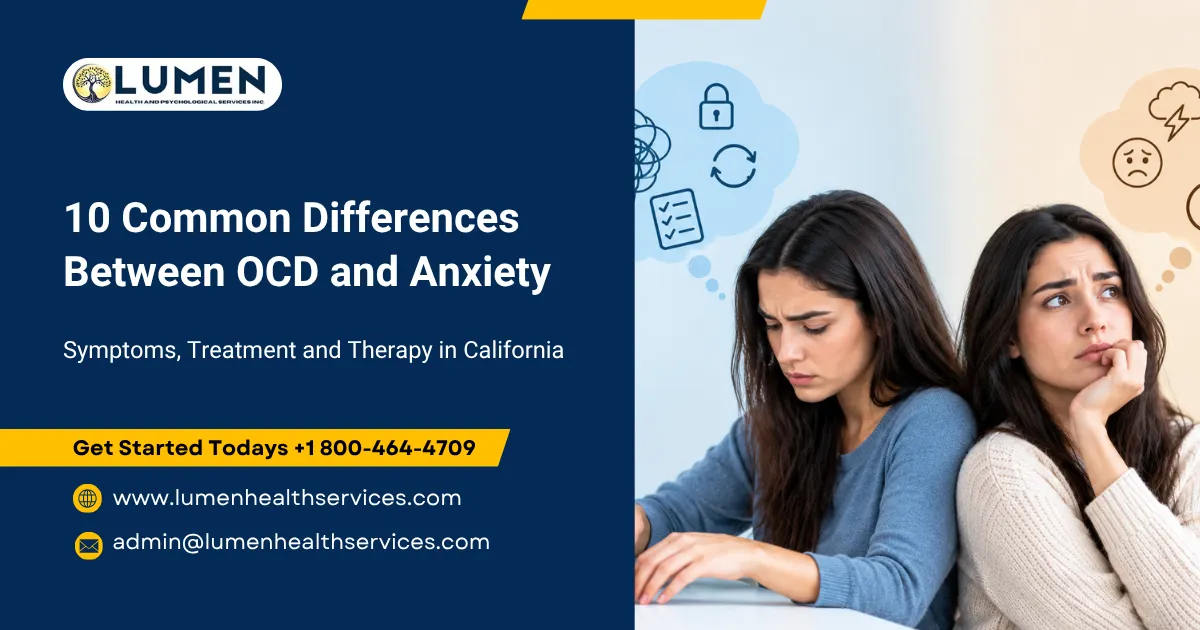
OCD and anxiety can both cause fear, distress, intrusive thoughts, physical symptoms, and avoidance, but they are different mental health conditions. The main difference is that obsessive-compulsive disorder (OCD) involves obsessions, compulsions, or both, while anxiety disorders primarily involve excessive fear or worry that is difficult to control. OCD is classified separately from anxiety disorders, although a person can experience both at the same time.
If you are looking for an “OCD symptoms vs anxiety” comparison or asking yourself, “Do I have OCD or anxiety?” It helps to understand the pattern of your thoughts and behaviors before determining if professional help is needed.
OCD vs. Anxiety: The Key Difference Explained
OCD involves recurring unwanted thoughts, images, or urges called obsessions. These experiences can create significant distress and may lead a person to perform repetitive behaviors or mental acts called compulsions.
Anxiety disorders generally involve persistent worry, fear, apprehension, or nervousness. The worry may involve health, relationships, work, school, finances, safety, or future events.
The two conditions can look similar because both can create intense anxiety. The important distinction is what happens in response to the distress.
With OCD, a person may experience an intrusive thought and then feel compelled to perform a behavior or mental ritual to reduce distress or prevent a feared outcome.
With anxiety, a person may repeatedly worry about a possible problem, try to predict what could happen, avoid the situation, or seek reassurance.
What Are OCD Symptoms?
OCD symptoms generally involve obsessions, compulsions, or both. According to the National Institute of Mental Health (NIMH), obsessions are recurring thoughts, urges, or mental images that are difficult to control, while compulsions are repetitive behaviors or mental acts performed in response to those experiences.
Obsessions
Obsessions are unwanted and recurring thoughts, images, or urges that cause distress. Common examples include fears about contamination, accidentally harming someone, making a serious mistake, losing control, or needing certainty about a particular situation.
Having an unwanted thought does not automatically mean you have OCD. The broader pattern, distress, compulsions, and effect on daily functioning matter.
Compulsions
Compulsions are repetitive behaviors or mental acts performed to reduce anxiety or prevent a feared event.
Examples may include repeatedly checking locks, excessive handwashing, counting, arranging objects, asking for reassurance, reviewing memories, or repeatedly searching for certainty.
Compulsions may provide temporary relief, but the relief often fades. This can reinforce the cycle of obsession, distress, and compulsion.
Mental Compulsions and Reassurance Seeking
Not every compulsion is visible.
Someone with OCD may mentally repeat words, review conversations, compare possibilities, check memories, analyze their feelings, or repeatedly ask another person for reassurance.
This can make OCD difficult to recognize because the person may not have obvious repetitive behaviors.
What Are Anxiety Symptoms?
Anxiety disorders can involve excessive worry, fear, nervousness, or apprehension that interferes with daily life.
Symptoms may include persistent worrying, restlessness, irritability, difficulty concentrating, muscle tension, sleep problems, rapid heartbeat, sweating, and feeling constantly on edge.
Anxiety can focus on realistic concerns, but the worry may become excessive, persistent, or difficult to control.
Different anxiety disorders can also produce different patterns. Generalized anxiety disorder, panic disorder, social anxiety disorder, and specific phobias do not all look the same.
Also Read: Anxiety Therapy for Adults in Citrus Heights, CA
OCD Symptoms vs. Anxiety Symptoms
The following comparison can help explain the main differences:
| Feature | OCD | Anxiety |
| Core concern | Unwanted intrusive thoughts, images, or urges that create distress | Excessive worry or fear about possible problems or threats |
| Thought pattern | Often repetitive, intrusive, unwanted, and difficult to dismiss | Often focused on potential future problems or ongoing concerns |
| Compulsions | Commonly involves behaviors or mental rituals used to reduce distress | Usually does not involve a specific compulsive ritual |
| Examples | Repeated checking, cleaning, counting, mental reviewing, or reassurance seeking | Worrying about health, work, relationships, finances, or everyday situations |
| Reassurance seeking | Can become a compulsion and provide temporary relief | May occur as an attempt to reduce uncertainty or worry |
| Physical symptoms | Can include tension, rapid heartbeat, sweating, and restlessness | Commonly includes tension, restlessness, rapid heartbeat, sweating, and sleep problems |
| Avoidance | May involve avoiding situations that trigger obsessions or compulsions | May involve avoiding situations associated with fear or worry |
| Relief after a behavior | Compulsions may temporarily reduce distress but reinforce the OCD cycle | Avoidance or reassurance may temporarily reduce worry but maintain anxiety |
| Daily impact | Obsessions and compulsions can consume time and interfere with daily functioning | Persistent worry and fear can affect work, school, relationships, sleep, and daily activities |
| Can they occur together? | Yes | Yes |
| Common therapy approaches | Exposure and Response Prevention (ERP) and CBT | CBT, exposure-based approaches, ACT, and other evidence-based therapies |
The key difference is not simply whether someone experiences anxiety. People with OCD often experience significant anxiety. The more useful question is whether intrusive thoughts and fears lead to compulsive behaviors or mental rituals.
How Do You Know If You Have OCD or Anxiety?
If you are wondering, “Do I have OCD or anxiety?”, look at the pattern rather than one isolated symptom.
OCD may be more likely when unwanted intrusive thoughts repeatedly lead to compulsions, mental rituals, checking, reassurance seeking, or attempts to achieve complete certainty.
An anxiety disorder may be more likely when excessive worry, fear, physical symptoms, or avoidance persist without the characteristic obsession-compulsion cycle.
However, these differences cannot replace a professional assessment. OCD, anxiety, depression, trauma-related conditions, and other mental health concerns can share symptoms.
A therapist can consider the frequency, intensity, triggers, duration, avoidance patterns, compulsions, and effect on daily functioning before recommending treatment.
Also Read: Signs You May Need Anxiety Counseling in Citrus Heights
Can You Have OCD and Anxiety Together?
Yes. OCD can occur alongside anxiety disorders and other mental health conditions.
NIMH reports that OCD commonly occurs with other mental health conditions, including anxiety and mood disorders. This overlap can make symptoms harder to understand without professional evaluation.
For example, someone may have OCD-related checking rituals while also experiencing generalized worry about work, relationships, or health.
When conditions overlap, treatment should address the complete symptom pattern rather than assuming every concern comes from one diagnosis.
How Are OCD and Anxiety Treated?
Treatment depends on the diagnosis, symptom severity, personal history, and individual needs.
Cognitive Behavioral Therapy
Cognitive behavioral therapy (CBT) is an evidence-based approach used for several anxiety disorders and other mental health conditions. CBT helps people identify patterns in thoughts, emotions, and behaviors and develop healthier responses.
Exposure and Response Prevention for OCD
Exposure and Response Prevention (ERP) is a specialized form of CBT that plays an important role in OCD treatment.
ERP gradually exposes a person to feared thoughts, situations, or sensations while helping them reduce or resist the compulsive response. The goal is not to eliminate every unwanted thought. Instead, treatment helps the person respond to uncertainty and distress without relying on compulsions.
ERP should be structured and appropriately paced by a qualified clinician.
Therapy for Anxiety
Depending on the anxiety disorder, treatment may include CBT, exposure-based therapy, Acceptance and Commitment Therapy (ACT), or other evidence-based approaches.
The appropriate approach depends on the person’s symptoms and clinical needs.
Medication and Coordinated Care
Some people may benefit from medication as part of treatment. Medication decisions require evaluation by an appropriately qualified medical professional who can consider symptoms, medical history, other medications, and individual circumstances.
Therapy and medication can sometimes work together as part of a broader treatment plan.
How Long Does OCD or Anxiety Therapy Take?
There is no single treatment timeline that works for everyone.
Some people notice changes within the early stages of therapy, while others need longer-term treatment. The timeline can depend on symptom severity, how long symptoms have been present, co-occurring conditions, treatment goals, and participation between sessions.
For OCD, ERP often involves repeated practice over time. Progress does not necessarily mean that intrusive thoughts disappear completely. A meaningful improvement may involve reduced compulsive behavior, greater tolerance of uncertainty, and less interference with everyday life.
When Should You See a Therapist for OCD or Anxiety?
Consider speaking with a mental health professional when intrusive thoughts, excessive worry, compulsive behaviors, avoidance, or reassurance seeking begin interfering with daily life.
You may also benefit from an evaluation if symptoms affect your sleep, relationships, work, school, concentration, or ability to complete normal activities.
You do not need to wait until symptoms become severe before seeking help. A professional assessment can help clarify what you are experiencing and identify appropriate treatment options.
OCD and Anxiety Therapy in California
If a person is looking for anxiety and OCD therapy, California providers can have varying needs. Some will require support with recognizing their symptoms, others might already have a diagnosis and require continued treatment.
Lumen Health & Psychological Services offers individual therapy for adults and other clients who are struggling with anxiety, depression, trauma, stress, and life transitions. In-person services are available in Citrus Heights, and telehealth is available throughout California.
If you aren’t sure if your symptoms are related to anxiety, OCD or other mental health issues, a professional assessment can help you get a good starting point.
Contact Lumen Health & Psychological Services to discuss your concerns and an appropriate next step if you have intrusive thoughts, persistent worry, compulsive behaviors, or avoidance that are interfering with your day-to-day life.
Final Thoughts
It is important to note that OCD and anxiety may overlap, but recognizing the distinction can help you find the right support. Typically, OCD includes obsessions and compulsions, whereas anxiety disorders mostly have excessive fear or worry. If a person is having persistent symptoms of OCD or anxiety, a trained mental health professional may be able to help identify what they might be suffering from and if it is appropriate to seek treatment.
If you are looking for OCD therapy in California, anxiety therapy, or anxiety and OCD treatment, contact Lumen Health & Psychological Services to discuss your concerns and available care options. Clients throughout can receive individual therapy and secure telehealth support.
FAQ’s
No. OCD is classified separately from anxiety disorders. However, anxiety is common among people with OCD, and OCD can occur alongside an anxiety disorder.
OCD involves obsessions and compulsions, while anxiety disorders primarily involve excessive fear or worry. Both conditions can cause significant distress and can occur together.
OCD commonly involves intrusive thoughts followed by compulsions or mental rituals. Anxiety commonly involves persistent worry, fear, physical symptoms, or avoidance. A qualified professional should make the diagnosis.
Yes. Anxiety can involve unwanted or distressing thoughts. Intrusive thoughts alone do not mean someone has OCD. The overall pattern and presence of compulsions are important.
Yes. OCD can occur alongside anxiety disorders, depression, and other mental health conditions. A professional assessment can help identify overlapping symptoms.
Exposure and Response Prevention (ERP), a specialized form of CBT, is an important evidence-based treatment for OCD. Treatment should be adapted to the person’s symptoms and goals.
Yes. Psychotherapy can be an important treatment for both OCD and anxiety. Whether medication would also be appropriate depends on the person’s symptoms, history, and clinical evaluation.
Online therapy can provide access to evidence-based psychotherapy for many people. The appropriate format depends on the person’s symptoms, treatment needs, clinician availability, and clinical circumstances.
Consider professional support when symptoms persist, cause significant distress, interfere with daily functioning, or lead to substantial avoidance, compulsions, or reassurance seeking.
Also Read:
Best Psychologist for Anxiety and Depression in Citrus
Signs You May Benefit from Individual Therapy
Signs You May Benefit From Anxiety Counseling
How Do I Know If Therapy Is Working
How Social Media Affects Teen Mental Health
10 Questions to Ask Before Starting Therapy