

The best type of psychotherapy in California depends on your symptoms, treatment goals, diagnosis, age, personal preferences, and the therapist’s training. Common evidence-based approaches include Cognitive Behavioral Therapy (CBT), Dialectical Behavior Therapy (DBT), Eye Movement Desensitization and Reprocessing (EMDR), Acceptance and Commitment Therapy (ACT), psychodynamic therapy, trauma-focused therapy, couples therapy, family therapy, and child and teen therapy.
There is no single psychotherapy that works best for everyone. The right approach should match the problem being treated and should be adjusted as your needs change. The American Psychological Association describes psychotherapy as a treatment that can address emotional reactions, thinking patterns, and behaviors through different therapeutic approaches.
What Are the Different Types of Psychotherapy?
Psychotherapy includes several approaches that use different techniques to address emotional, behavioral, and relationship concerns. Some therapies focus on changing thoughts and behaviors, while others focus on emotional regulation, trauma processing, relationships, or long-standing patterns.
NIMH notes that research supports several psychotherapies for conditions such as depression and anxiety, although evidence and suitability vary by condition and individual.
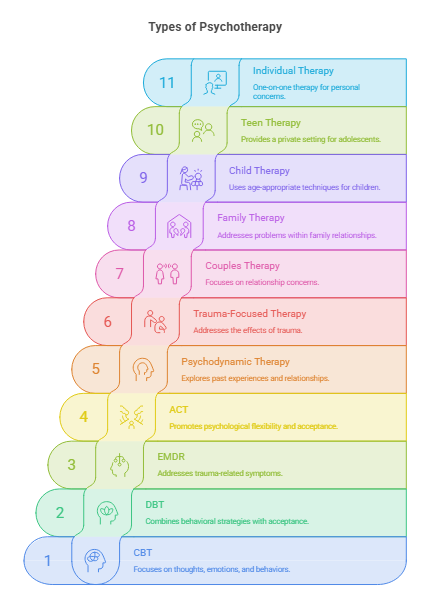
Here are 10 important psychotherapy approaches and treatment formats to understand.
1. Cognitive Behavioral Therapy (CBT)
Cognitive Behavioral Therapy is one of the most widely used psychotherapy approaches. CBT focuses on the relationship between thoughts, emotions, and behaviors.
A therapist may help you identify unhelpful thinking patterns, examine how those thoughts affect your behavior, and practice healthier responses.
CBT can be useful for:
- Anxiety
- Depression
- Panic symptoms
- Stress
- Insomnia
- Some phobias
- Other behavioral and emotional concerns
CBT often involves practical exercises between sessions. Treatment usually has specific goals, although the exact structure varies by person.
NIMH describes CBT and exposure-based approaches as evidence-based psychotherapies used for anxiety and other mental health conditions.
Is CBT the best therapy for anxiety and depression?
CBT is an effective option for many people with anxiety and depression, but it is not automatically the best choice for everyone. A therapist should consider your symptoms, history, preferences, and treatment goals before selecting an approach.
2. Dialectical Behavior Therapy (DBT)
Dialectical Behavior Therapy combines behavioral strategies with acceptance and emotional regulation skills.
DBT commonly teaches:
- Mindfulness
- Distress tolerance
- Emotional regulation
- Interpersonal effectiveness
It may be especially useful for people who experience intense emotions, difficulty managing impulses, self-harm behaviors, or significant relationship difficulties.
DBT developed from CBT but places greater emphasis on accepting difficult emotions while building skills for meaningful change.
3. Eye Movement Desensitization and Reprocessing (EMDR)
EMDR is a structured therapy commonly used for trauma-related symptoms and PTSD.
During EMDR, a trained therapist helps the person recall aspects of a distressing experience while using bilateral stimulation, such as guided eye movements or other forms of alternating stimulation.
The goal is to reduce the emotional distress connected with traumatic memories and help the person develop more adaptive responses.
EMDR has been studied extensively for trauma-related conditions, although treatment response varies and not every person with trauma needs EMDR.
Lumen Health Services offers EMDR therapy as one of its specialty treatment options, making this approach particularly relevant for people seeking trauma-focused care in California.
4. Acceptance and Commitment Therapy (ACT)
Acceptance and Commitment Therapy helps people respond differently to difficult thoughts and emotions rather than spending all their energy trying to eliminate them.
ACT focuses on psychological flexibility, acceptance, mindfulness, personal values, and meaningful action.
A therapist may help you identify what matters to you and develop practical steps that move you toward those values while learning to manage difficult internal experiences.
ACT may be considered for anxiety, depression, chronic stress, and other concerns where avoidance or rigid patterns interfere with daily life.
5. Psychodynamic Therapy
Psychodynamic therapy examines emotional patterns, relationships, past experiences, and recurring behaviors that may influence current difficulties.
Instead of focusing only on immediate symptoms, therapy may explore why certain emotional or relationship patterns continue to occur.
This approach can be helpful for people who want to understand recurring relationship difficulties, emotional conflicts, self-esteem concerns, or patterns that have continued over time.
The APA identifies psychodynamic approaches as one of the major categories of psychotherapy.
6. Trauma-Focused Therapy
Trauma-focused therapy addresses the psychological effects of traumatic or highly distressing experiences.
Treatment may include approaches such as trauma-focused CBT, cognitive processing strategies, exposure-based treatment, or EMDR depending on the person’s symptoms and clinical needs.
Trauma treatment should move at an appropriate pace. A therapist may first focus on safety, coping skills, emotional regulation, and stabilization before working directly with traumatic memories.
Not every person who has experienced trauma needs the same treatment. A clinical assessment can help determine which approach is appropriate.
7. Couples Therapy
Couples therapy focuses on relationship concerns involving communication, trust, conflict, emotional connection, intimacy, or major life changes.
Therapists may help couples identify unhealthy interaction patterns and develop more effective ways to communicate and respond to each other.
Couples therapy may help with:
- Repeated arguments
- Communication problems
- Trust concerns
- Relationship transitions
- Parenting disagreements
- Emotional disconnection
- Separation or reconciliation decisions
Lumen provides couples therapy for California individuals and families who want professional support with relationship concerns.
8. Family Therapy
Family therapy looks at problems within the context of family relationships rather than focusing only on one individual.
A therapist may help family members improve communication, understand different perspectives, establish healthier boundaries, and work through recurring conflict.
Family therapy may be useful when mental health symptoms affect the entire household or when family communication contributes to ongoing stress.
Lumen provides family therapy as part of its broader mental health services.
9. Child Therapy
Children may communicate emotional distress differently from adults. Changes in behavior, school performance, sleep, mood, social interaction, or family relationships can sometimes indicate that a child needs additional support.
Child therapy uses age-appropriate communication and therapeutic techniques.
Treatment may address:
- Anxiety
- Emotional regulation
- Behavioral concerns
- Family changes
- School-related stress
- Self-esteem
- Social difficulties
- Grief and adjustment
The therapist considers the child’s developmental stage and may work with parents or caregivers as part of treatment.
10. Teen Therapy
Teen therapy provides adolescents with a private and developmentally appropriate setting to discuss emotional, social, academic, and family concerns.
Teenagers may seek therapy for anxiety, depression, school stress, low self-esteem, social pressure, anger, family conflict, or major life transitions.
Lumen provides secure telehealth teen therapy across California and in-person sessions at its Citrus Heights office. Its teen services use evidence-based and age-appropriate approaches and can coordinate individual teen therapy with family therapy when appropriate.
11. IndividuaI Therapy
Individual therapy is one-on-one therapy between a client and a licensed mental health professional. It provides a private setting to discuss personal concerns, understand patterns of thoughts and emotions, and develop practical ways to manage mental health challenges.
Individual therapy can help with anxiety, depression, stress, trauma, low self-esteem, grief, relationship concerns, life transitions, and other emotional difficulties. The therapist may use different approaches depending on the person’s needs, such as Cognitive Behavioral Therapy (CBT), trauma-focused therapy, EMDR, or other evidence-based techniques.
Who Can Benefit From Individual Therapy?
Individual therapy can be helpful for adults, teens, and children who are experiencing emotional, behavioral, or relationship-related concerns. It may be appropriate when symptoms begin affecting daily activities, work, school, relationships, sleep, or overall quality of life.
Therapy can also be useful when someone does not have a specific diagnosis but wants support with coping skills, personal challenges, major life changes, or recurring emotional patterns.
Which Type of Psychotherapy Is Best for Anxiety?
CBT is commonly used for anxiety because it addresses patterns of thinking, avoidance, and behavior that can maintain anxiety symptoms. Exposure-based approaches may also be appropriate for specific anxiety disorders, phobias, and OCD.
The most appropriate treatment depends on the type and severity of anxiety. A person with panic attacks may need a different treatment plan from someone experiencing generalized anxiety, social anxiety, or trauma-related anxiety.
NIMH notes that exposure therapy is a form of CBT that can help people gradually tolerate anxiety-provoking situations or thoughts in a structured therapeutic setting.
What Therapy Is Best for Depression?
Several psychotherapy approaches can help with depression. CBT is one commonly used option, while other approaches may also be appropriate depending on the person’s symptoms, relationships, history, and treatment goals.
Therapy may address negative thinking patterns, withdrawal, loss of motivation, relationship difficulties, coping skills, and behavioral changes.
For moderate or severe depression, a healthcare professional may also discuss medication or combined treatment when clinically appropriate.
What Therapy Is Best for Trauma and PTSD?
Trauma-focused treatments can be appropriate for PTSD and trauma-related symptoms. EMDR, trauma-focused CBT, cognitive processing approaches, and exposure-based treatments are among the approaches used in trauma treatment.
Treatment should be individualized. A therapist should consider current symptoms, safety, emotional stability, trauma history, and treatment goals before beginning trauma processing.
How Do You Choose the Right Therapist in California?
Choosing therapy involves more than choosing a treatment name.
Consider whether the therapist:
- Holds an appropriate California license or credential
- Has experience treating your specific concern
- Uses an approach supported by research for your condition
- Explains how treatment will work
- Sets realistic goals
- Respects your preferences and cultural background
- Offers a format that works for your schedule
- Makes you feel safe enough to communicate honestly
The therapeutic relationship also matters. APA explains that treatment decisions can depend on current research, the therapist’s theoretical orientation, and what works best for the individual’s situation.
Is Online Psychotherapy Effective in California?
Online psychotherapy can provide access to licensed mental health care without requiring every appointment to take place in an office.
Telehealth can be especially useful for people who live far from a therapist, have transportation challenges, have busy schedules, or feel more comfortable receiving therapy from home.
Lumen provides secure telehealth therapy across California, with in-person services available at its Citrus Heights office.
Online therapy is not appropriate for every situation. A provider should assess whether telehealth is clinically suitable for the person’s needs and circumstances.
How Long Does Psychotherapy Take?
There is no fixed number of sessions that works for everyone.
Some people benefit from short-term therapy focused on a specific concern. Others need longer-term treatment for persistent or complex mental health conditions.
Treatment length depends on factors such as diagnosis, symptom severity, treatment goals, previous experiences, response to therapy, and the type of psychotherapy being used.
A good treatment plan should include opportunities to review progress and adjust the approach when needed.
Final Thoughts
The goal is not to find a therapy with the most impressive name. The goal is to find treatment that fits your symptoms, needs, preferences, and goals.
CBT may be appropriate for certain anxiety and depression concerns. DBT may help with emotional regulation. EMDR and other trauma-focused approaches may be appropriate for trauma-related symptoms. Couples and family therapy can address relationship patterns, while child and teen therapy uses developmentally appropriate care.
Lumen Health Services provides individual, couples, family, child, and teen therapy, along with specialty approaches including EMDR and Brainspotting. Its clinicians in-person care in Citrus Heights and secure telehealth services across California.
FAQ’s
Common approaches include CBT, DBT, psychodynamic therapy, ACT, trauma-focused therapy, EMDR, and exposure-based therapy. Couples, family, child, and teen therapy are treatment formats that may use different therapeutic approaches depending on the person’s needs.
There is no single therapy that is most effective for every person or condition. Evidence varies by diagnosis and treatment approach, so the best choice depends on your symptoms, goals, therapist expertise, and preferences.
CBT and exposure-based approaches are commonly used for anxiety disorders. A therapist can determine which approach fits your specific symptoms.
CBT and several other evidence-based psychotherapies can help with depression. Your provider may recommend therapy alone or discuss combined treatment depending on symptom severity and individual circumstances.
EMDR is an established trauma-focused treatment that has been studied for PTSD and trauma-related symptoms. However, treatment response varies, and a qualified clinician should determine whether EMDR is appropriate for you.
Online therapy can be an appropriate way to receive psychotherapy when telehealth is clinically suitable. Lumen provides secure online therapy throughout California.
Look for an appropriately licensed therapist with experience treating your specific concern. Ask about their therapeutic approach, treatment goals, expected progress, session format, and whether they provide in-person or secure telehealth services.
The number of sessions varies. Your treatment goals, symptoms, diagnosis, response to therapy, and chosen treatment approach all influence how long therapy may continue.
Also Read:
10 Benefits of Mental Health Therapy
Signs You May Benefit from Individual Therapy
How Do I Know If Therapy Is Working?
Mental Health Statistics in America
Understanding the Early Signs of Depression
10 Questions to Ask Before Starting Therapy
Best Psychologist for Anxiety and Depression in Citrus Heights, CA